Why Predicting Solar Flares Is So Challenging
Solar flares don’t happen often. These intense bursts of solar activity can disrupt satellites, power grids, and communications on Earth. Their rarity is exactly what trips up traditional machine learning models. When flares occur in less than 1% of observations, a model that always says “no flare” still scores 99% accuracy. That number sounds impressive—until you realize it’s meaningless where the stakes are so high.
The real challenge isn’t just spotting flares but anticipating the extreme, high-impact ones that cause the most damage. Conventional metrics like accuracy or precision treat these rare events as statistical noise. This creates a blind spot: models look successful on paper but fail when it matters most. Researchers have had to rethink how we evaluate and train predictive systems for solar flares, pushing toward metrics and models that focus on extremes rather than the routine.
A New Approach to Rare Event Forecasting
Traditional machine learning stumbles with rare, impactful events like solar flares. The problem starts with standard accuracy metrics. If flares happen only 1% of the time, a model always predicting “no flare” still hits 99% accuracy. That’s misleading. It hides the model’s failure to catch critical spikes.
Researchers turned to the True Skill Statistic (TSS) to fix this. Unlike plain accuracy, TSS balances true detections against false alarms, offering a clearer view of performance. Still, even TSS doesn’t fully solve the problem: extreme flares are outliers, and traditional classifiers get overwhelmed by the flood of uneventful data.
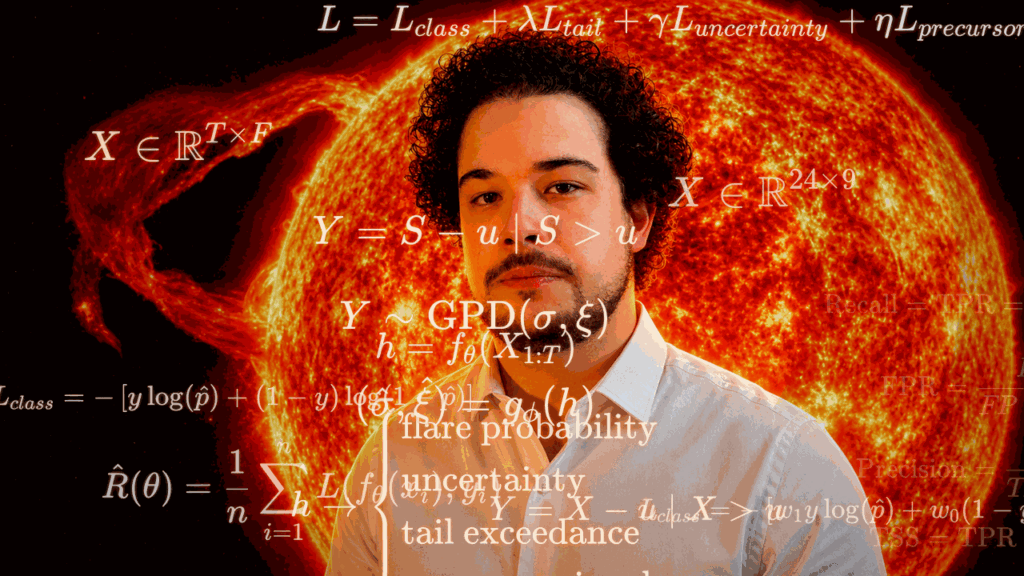
That’s where the Generalized Pareto Distribution (GPD) tail model comes in. Instead of treating all flares equally, it focuses learning on the extreme tail—the rare, high-magnitude flares that matter most. By modeling tail risk explicitly, the system prioritizes detecting worst-case scenarios rather than being diluted by routine events.
The data comes from NASA’s Solar Dynamics Observatory magnetograms. These images measure magnetic flux, helicity, and twist—key signs of energy buildup in the sun’s corona. These features serve as proxies to anticipate when and where flares might erupt.
The model architecture is a transformer with dual heads: one predicts whether a flare will occur, the other estimates severity using the GPD tail. This dual setup captures both the binary event and its potential magnitude in one framework.
This approach isn’t limited to solar flares. Any domain facing rare, catastrophic events—floods, grid failures, financial crashes—struggles with class imbalance and extreme outcomes. This method offers a promising way to sharpen risk assessment where it counts.
What This Means Beyond Space Weather
The ripple effects of this new modeling approach extend far beyond the realm of space weather prediction. Industries that grapple with rare but devastating events—think power grid operators, flood risk managers, and financial institutions—stand to benefit from a more nuanced understanding of extreme risks. Traditional machine learning models often fail here because they treat every event as equally important, drowning out the rare catastrophes in a sea of normalcy. By contrast, integrating tail-focused methods like the Generalized Pareto Distribution shifts the spotlight directly onto the extremes, enabling earlier and more reliable warnings.
For decision-makers, this means a chance to allocate resources more effectively. Instead of reacting to every minor anomaly, they can prioritize prevention and mitigation efforts where the stakes are truly high. Take grid operators, for instance: knowing not just if a failure might occur but how severe it could be alters maintenance schedules and emergency response strategies. Similarly, financial risk managers can better quantify the odds and potential impact of extreme market moves, refining stress tests and capital reserves.
Policy frameworks may also evolve as these methods gain traction. Regulators could demand risk assessments that reflect the full spectrum of possible outcomes rather than average-case scenarios. This would promote resilience planning that’s genuinely aligned with worst-case possibilities, not just the most frequent ones. Yet, adopting these techniques requires a shift in mindset—acknowledging that rare events, though infrequent, carry outsized consequences that standard metrics often obscure.
In practice, the challenge lies in integrating these sophisticated models into existing workflows without overwhelming analysts or decision-makers. Transparency and interpretability remain crucial; a model that flags a severe solar flare or flood risk must also provide actionable insight, not just a cryptic score. The promise is clear: better-tailored forecasts that empower stakeholders to act with foresight rather than hindsight, transforming rare-event prediction from an academic exercise into a practical tool for safeguarding critical systems and communities.
Key Points to Remember
Predicting rare but powerful solar flares demands more than conventional machine learning tools. Relying solely on accuracy risks mistaking a model that never predicts flares for a successful one—because flares are so infrequent, “no flare” guesses dominate by default. Metrics like the True Skill Statistic (TSS) provide a clearer picture by balancing correct detections against false alarms.
Traditional models often miss extreme events—the ones that cause real damage. Integrating a Generalized Pareto Distribution focuses learning on flare severity, shifting attention to tail risks: rare, high-impact flares that disrupt satellites, power grids, and communications.
This isn’t just about space weather. The same principles apply wherever rare disasters hide beneath overwhelming normalcy—floods, blackouts, financial crashes. When evaluating risk forecasts, ask: does the model distinguish rare but critical events from noise? Can it estimate how severe the worst-case might be? If not, the forecast could lull you into a false sense of security.
Global Digests News delivers timely, credible coverage of world affairs, politics, economy, and technology to keep you informed on today’s top stories.