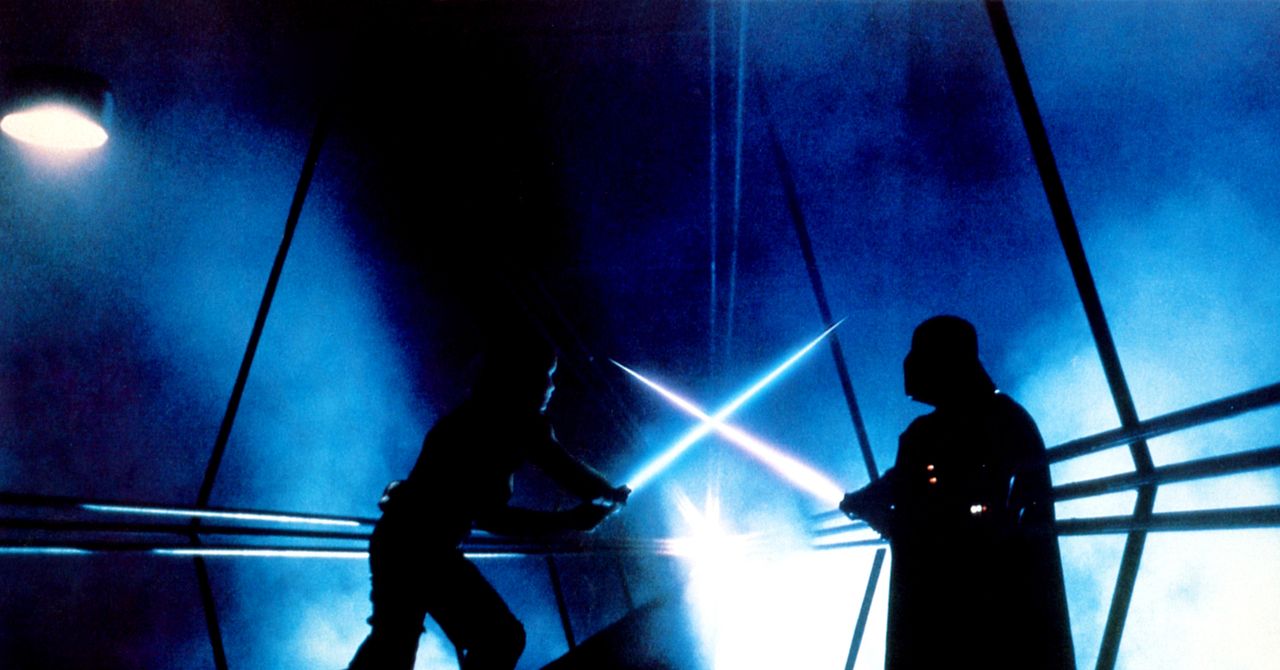
Understanding the Mystery of Lightsaber Mass
Recent analyses have reignited the debate over whether lightsaber blades, iconic in the Star Wars universe, possess physical mass or are merely beams of light. This question matters now more than ever as advances in physics and visual effects challenge traditional interpretations, demanding a clearer understanding of how these weapons could function in reality.
Unlike pure laser beams, which are massless and intangible, lightsabers exhibit behaviors—such as weighty swings, impacts, and even the ability to be thrown—that strongly imply they have mass or at least a physical presence. This development compels us to reconsider the science behind their design, moving beyond simple light to concepts like plasma fields or contained energy constructs, bridging fiction with plausible physics and deepening the narrative’s immersive power.
Physics Insights into Lightsaber Blade Behavior
Recent analyses of lightsaber blades delve into their physical properties by applying fundamental physics principles to the iconic Star Wars weapon. While the blades visually resemble laser beams, pure light lacks mass and the ability to exert force, which poses a challenge in explaining how lightsabers function as melee weapons.
Physicists and science communicators have noted that the combat choreography—featuring swinging, blocking, and even throwing lightsabers—implies the blades behave as if they have tangible mass. This is especially evident in the rotational dynamics during duels, where the moment of inertia plays a critical role in how the weapon’s blade responds to forces exerted by the wielder.
One prevailing interpretation is that lightsabers are not mere beams of light but rather plasma fields contained within a magnetic or energy-based sheath. Plasma, being ionized gas, possesses mass and can interact physically with other objects, providing a plausible explanation for the blade’s solidity and impact resistance depicted in the films.
Understanding these physics insights helps reconcile the fictional portrayal of lightsabers with real-world scientific concepts. It elevates the narrative by grounding the weapon’s behavior in plausible physical mechanisms, thereby enhancing the suspension of disbelief for audiences and enriching the Star Wars universe’s internal consistency.
Lightsabers in Star Wars: Fiction Meets Science
Lightsabers, the iconic energy swords of the Star Wars universe, captivate audiences not only through their vivid glow but also through their dynamic presence in combat. Unlike conventional blades, these luminous weapons challenge our understanding of physics by seemingly combining the properties of light and solid matter. While the films portray lightsabers as beams of energy capable of cutting through almost anything, the way characters wield and clash them suggests that these blades have tangible mass and momentum. This paradox lies at the heart of ongoing debates among scientists and fans alike: can a blade made of light or plasma possess physical weight? To appreciate the current scientific analysis, it’s essential to recognize that pure laser light, as understood in physics, carries no rest mass and cannot be swung or blocked like a solid object. Yet, the choreography and impact of lightsaber duels imply a physical presence, prompting theories that the blades are stabilized plasma fields or contain some form of contained matter. Understanding this conceptual bridge between Star Wars fiction and real-world physics sets the stage for a deeper exploration of how lightsaber blades might conform to—or defy—known scientific principles, enriching both the storytelling and the technological imagination behind these legendary weapons.
Why Lightsaber Mass Matters for Realism and Storytelling
The question of whether lightsaber blades possess mass is more than a theoretical curiosity—it has tangible implications for both the realism of Star Wars’ iconic combat sequences and the broader storytelling framework. For audiences and creators alike, attributing mass to lightsabers helps ground the fantastical elements in a form of physical plausibility, enhancing immersion and emotional engagement. From a practical standpoint, if lightsabers behaved as massless beams of light, the choreographed duels would lose their visceral weight and impact; the resistance and momentum felt during clashes are crucial to conveying skill, tension, and consequence.
For the science and technology community, this analysis bridges speculative fiction and real-world physics, encouraging a more nuanced understanding of plasma dynamics and electromagnetic fields. It opens pathways to exploring how advanced energy-based tools might function, influencing research in plasma containment and weaponry concepts. Moreover, for educators and communicators, the discussion provides a compelling case study to illustrate complex physics principles—such as moment of inertia and energy-matter interactions—in an accessible, culturally resonant context.
In the entertainment industry, acknowledging the implied mass of lightsabers informs visual effects design and stunt choreography, ensuring that the portrayal of these weapons aligns with audience expectations of physicality and consequence. This approach also deepens narrative stakes, as the tangible presence of the blades underscores the risks and skill involved in combat, reinforcing character development and plot tension.
Ultimately, recognizing lightsaber mass as a meaningful concept enriches the Star Wars universe’s internal consistency and invites ongoing dialogue between science and storytelling. It exemplifies how thoughtful integration of scientific principles can elevate speculative fiction, making the impossible feel convincingly real and dramatically compelling.
Future Explorations of Lightsaber Physics
As the scientific community and Star Wars enthusiasts continue to dissect the physics behind lightsaber blades, several key developments warrant close attention. First, advances in plasma physics and magnetic confinement technologies could provide tangible models that approximate how a lightsaber’s blade might maintain a stable, bounded form with effective mass-like properties. Monitoring breakthroughs in controlled plasma fields or magnetically contained energy beams will offer critical insights into the feasibility of such constructs beyond fiction.
Secondly, improvements in high-speed motion capture and simulation tools used in film production are likely to reveal more nuanced depictions of the blades’ interactions with the environment and combatants. These technical milestones can deepen our understanding of the implied physical characteristics—such as inertia and impact force—that the Star Wars universe suggests. Observing how filmmakers blend scientific principles with storytelling techniques will remain essential for appreciating the evolving realism of lightsaber physics.
Finally, ongoing interdisciplinary research bridging quantum optics, thermodynamics, and materials science may shed light on the theoretical limits and possibilities of energy-based weapons. While pure laser light lacks mass, engineered plasma or photon-based fields with emergent physical effects could redefine our approach to energy projection and containment. Staying informed about these scientific frontiers will clarify which aspects of lightsaber physics remain firmly in the realm of imaginative fiction and which might inspire future technological innovation.
In sum, the next signals to watch are grounded in measurable scientific progress and refined cinematic representation. These developments will continue to shape our understanding of lightsaber blades—not only as iconic elements of storytelling but as intriguing subjects at the intersection of physics and creative imagination.
Frequently Asked Questions About Lightsaber Mass
From a strict physics standpoint, pure light—such as laser beams—does not have rest mass and cannot exert the kind of physical force implied by a lightsaber’s behavior. However, the depiction of lightsabers in Star Wars suggests they are not merely beams of light but rather plasma or energy fields contained within a magnetic or force field. This conceptualization allows for a blade with effective mass and solidity, even if it defies conventional physics.
How do Star Wars combat scenes suggest the presence of mass in lightsabers?
In the films, lightsabers are swung, parried, and even thrown, all of which imply they have inertia and momentum. The characters’ movements and the impact effects on objects and other blades convey a tangible weight and resistance. These combat dynamics are key narrative cues that the blades possess physical properties beyond mere illumination.
What physics concepts help explain the behavior of lightsaber blades?
Concepts such as rotational motion, moment of inertia, and plasma physics provide frameworks to analyze lightsaber behavior. The moment of inertia relates to how the blade’s mass distribution affects its rotation during combat, while plasma physics offers a plausible explanation for how an energy field could maintain a fixed shape and interact physically with the environment.
Why is understanding the mass of lightsabers important for their realism?
Determining whether lightsabers have mass influences how audiences perceive their believability and the stakes of combat scenes. A blade with mass makes the choreography and physical interactions more credible, enhancing immersion. It also deepens the storytelling by grounding fantastical elements in relatable physical principles, bridging fiction and science.

Global Digests News delivers timely, credible coverage of world affairs, politics, economy, and technology to keep you informed on today’s top stories.

Bohmian Mechanics: Revisiting Quantum Determinism After New Tests
Bohmian mechanics, once sidelined, returned to focus after a 2025 photon tunneling experiment tested its deterministic claims. The results…
Dark Matter Detection: Innovations Inspired by Henry Cavendish's Experiment
A modern take on Henry Cavendish’s 18th-century torsion balance proposes nested metal shells and ultra-sensitive voltage measurements to de…

Greenland’s Ice Melt Surges Since 1990
Greenland’s ice melt has accelerated sixfold since 1990, driven mainly by rising temperatures rather than atmospheric shifts. Extreme melt…

Health Insurance Marketplaces Leak Sensitive Data to Ad Tech Giants
Nearly all U.S. state health insurance marketplaces have exposed sensitive applicant data—including citizenship and race—to major ad tech f…

Instagram’s Voluntary AI Creator Label: A Tentative Step Toward Transparency
Instagram has launched an optional “AI creator” label for posts generated or altered by AI. Without automated detection, the system relies…

Uber’s Ambitious Expansion and Innovation
Uber CEO Dara Khosrowshahi lays out a vision to transform Uber into a travel and service platform. By integrating Expedia hotel bookings an…

Claude Code Cost Control: Context Architecture Over Prompt Optimization
Claude Code’s costs stem less from prompt length and more from accumulated context—files, memory, and tool outputs that build up each sessi…

Leonardo da Vinci’s DNA May Finally Be Decoded
Researchers have mapped a 21-generation paternal lineage from 1331 to today, identifying 15 living male descendants of Leonardo da Vinci. G…