Why Anonymization Matters in Data Science
Data science increasingly depends on vast troves of sensitive production data. Names, emails, phone numbers—these identifiers enrich datasets but also expose them to privacy risks. Anonymization has shifted from optional best practice to an essential safeguard against legal penalties and reputational damage.
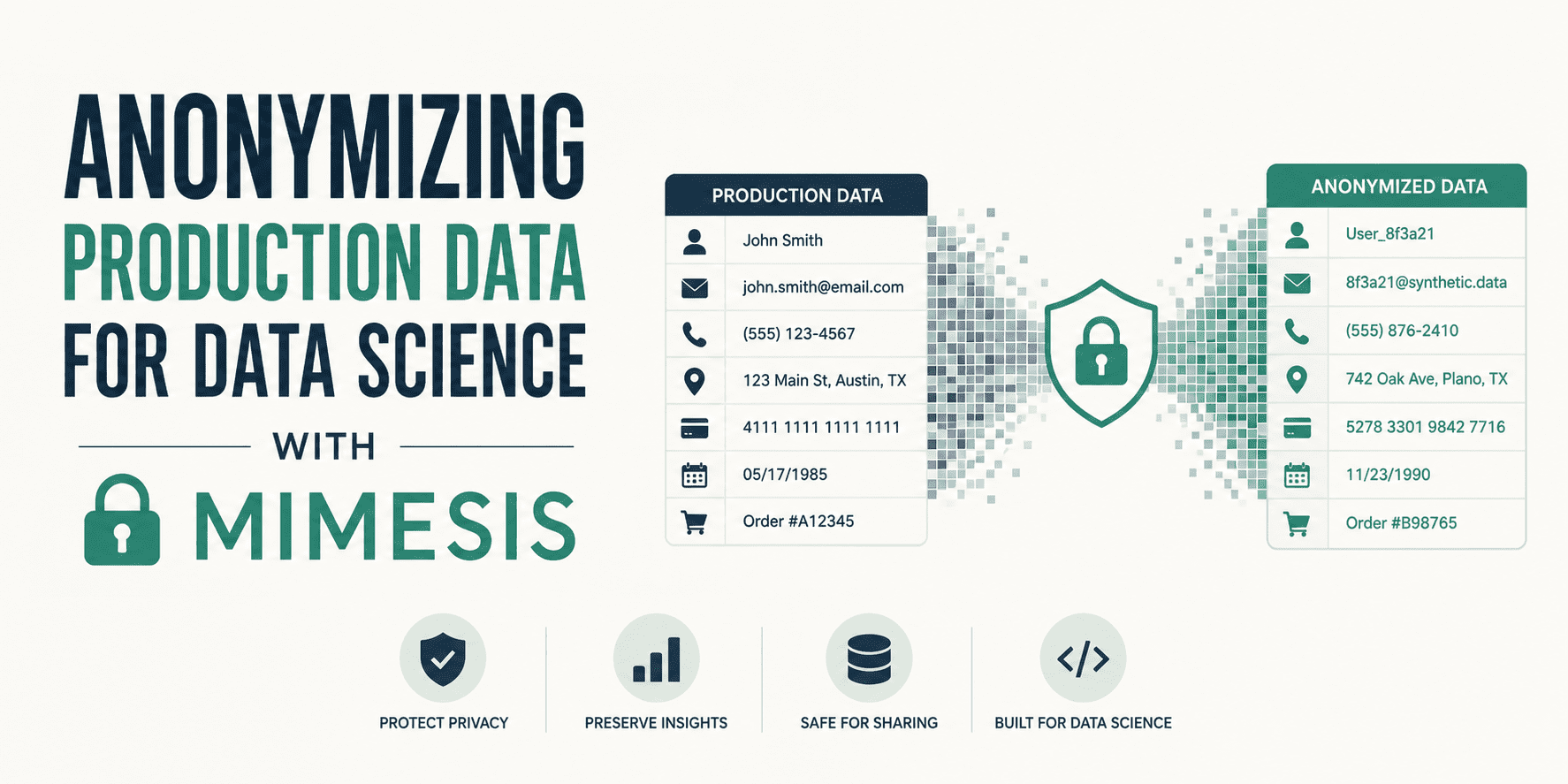
Mimesis, an open-source Python library, offers a practical way to generate realistic fake data locally. It replaces sensitive fields while preserving dataset structure, letting data scientists analyze without exposing real personal information. But how well does it walk the line between realism and privacy? What risks lurk when synthetic data feeds complex production workflows? These questions highlight why anonymization demands scrutiny—not blind trust in any single tool.
How Mimesis Generates Realistic Synthetic Data
Mimesis generates synthetic data by mimicking the statistical properties and formats of real datasets. It taps into predefined data providers—modules simulating names, addresses, emails, phone numbers, job titles, and more—drawing from localized datasets to produce culturally relevant outputs.
Users start by defining the dataset schema and pinpointing which columns to anonymize. Mimesis then replaces real values with synthetic counterparts that maintain original distributions and formatting patterns. For example, user names are swapped for plausible alternatives preserving first and last name distributions. Phone numbers and emails follow valid formats to keep downstream validations intact.
A standout feature is seeding the random number generator. Fixing a seed means the same synthetic dataset can be reproduced exactly—critical for debugging, audits, and compliance verification.
Implementation involves instantiating relevant providers, often with locale settings, then generating replacements row by row. This preserves the dataset’s shape and essential characteristics, enabling meaningful analysis without real personal data.
Yet, Mimesis’s reliance on predefined pools means it may miss nuances in highly specialized or proprietary data. It doesn’t inherently defend against sophisticated re-identification attacks; synthetic data can leak subtle correlations if the original dataset is sparse or contains unique entries.
Still, as an open-source tool, Mimesis balances realism, configurability, and reproducibility well, making it a practical choice for engineering teams aiming to anonymize production data responsibly.
Limitations and Risk Considerations in Data Anonymization
No anonymization tool is foolproof, and Mimesis carries inherent trade-offs. While it produces realistic synthetic data that preserves structure, it cannot guarantee immunity from advanced re-identification techniques. Synthetic records, derived statistically from original data, may inadvertently expose sensitive patterns—especially when rare or outlier data points exist.
Its deterministic seeding aids reproducibility but can become a vulnerability if seeds or generation logic leak, enabling attackers to predict synthetic outputs. Mimesis focuses on common data types and may struggle with complex or nested fields without custom extensions, increasing implementation complexity and risk of gaps.
Performance also matters. Large or high-dimensional datasets can slow generation, creating bottlenecks. Unlike enterprise solutions, Mimesis lacks built-in differential privacy or formal privacy budgets, which regulators increasingly expect. This absence means teams must layer additional protections and conduct thorough risk assessments.
In practice, Mimesis is a valuable but partial solution. Overreliance without domain knowledge, rigorous testing, and continuous monitoring risks complacency and potential data leaks. Responsible deployment requires understanding its limits and integrating it into a comprehensive privacy strategy.
Practical Insights for Using Mimesis Effectively
Mimesis provides a cost-effective, adaptable way to anonymize sensitive production data while preserving the nuances that make datasets analytically valuable. Its realistic, locale-aware synthetic data generation means you’re not merely scrambling identifiers but maintaining structural integrity critical for reliable modeling.
This isn’t a plug-and-play fix. Careful configuration, including seeding for reproducibility, is vital to avoid subtle biases or inconsistencies that could skew downstream results. Using Mimesis locally reduces privacy risks compared to cloud-based anonymization but demands rigorous validation.
The open-source nature invites customization but requires technical expertise to avoid pitfalls common in simplistic deployments. For teams willing to invest upfront effort, Mimesis can serve as a transparent, controllable component of a broader data governance framework—balancing data utility with privacy risk mitigation, as long as its limitations are respected and monitored over time.