AI Code Generation and Hidden Risks in IoT

AI code generation is speeding up IoT software development but at a stealthy cost. The rush to automate coding tasks has exposed a new kind of technical debt rooted in what experts call “contextual mismatch.” AI tools often optimize code snippets for local correctness without fully accounting for broader system constraints—hardware limits, architectural standards, or the complex interplay between firmware, gateways, and telemetry pipelines. This isn’t a minor glitch. In industrial IoT setups, a single flawed AI-generated pattern can ripple through thousands of devices simultaneously, creating systemic vulnerabilities. Recent data shows over 15% of AI-generated commits across 6,000 repositories still carry unresolved quality issues. Worse, duplicated code has jumped from 8.3% to 12.3% in just four years. Compounding the problem, less than half of developers rigorously review AI output before pushing changes. Without tighter human oversight and tailored monitoring—especially focused on edge memory and device-gateway latency—this hidden technical debt could quietly undermine IoT reliability on a massive scale.

Rising Technical Debt in AI-Generated IoT Code

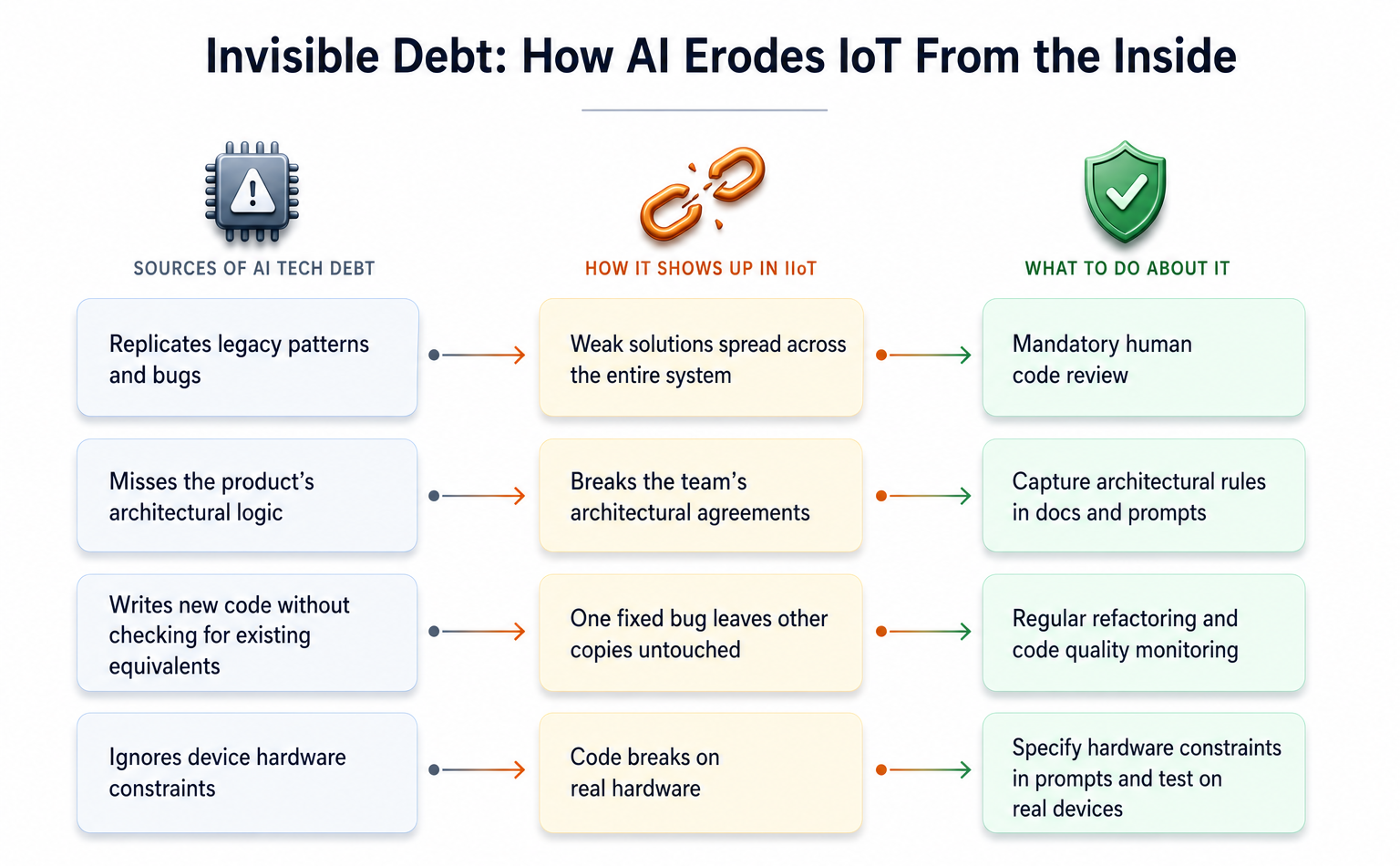
AI-generated code has sped up IoT software development dramatically, but it has also brought a new form of technical debt that’s harder to spot. This debt arises mainly from a “contextual mismatch.” AI tools often optimize code snippets for local correctness—making sure a function works as expected in isolation—while ignoring broader system constraints like hardware limits, cross-component dependencies, or architectural standards. In industrial IoT (IIoT) setups, this problem multiplies. A single flawed code pattern can ripple through firmware, gateways, and telemetry pipelines, impacting thousands of devices simultaneously. Between 2020 and 2024, duplicated code in AI-generated commits across 6,000 repositories jumped from 8.3% to 12.3%. More than 15% of these commits contained unresolved quality issues. Even more concerning, less than half of developers consistently review AI-generated code before pushing it live. The risks here aren’t just theoretical. Faulty code in edge devices can cause memory overflows or latency spikes that cascade through the network, degrading system reliability without triggering traditional service-level alarms. Experts now recommend enforcing mandatory human code reviews combined with automated guardrails. They also suggest carving out no-go zones in the codebase—especially in safety-critical components—to prevent unchecked AI edits. Targeted monitoring is essential too. Instead of focusing solely on service metrics, teams need IoT-specific indicators like edge memory usage and device-to-gateway latency. Without these measures, the rapid pace AI enables could quietly accelerate systemic risk accumulation across entire IoT ecosystems.

How AI Accelerates IoT Development with Trade-Offs

AI has undeniably sped up IoT software creation, slashing development cycles and automating routine coding tasks. Developers can now generate firmware snippets, gateway logic, and telemetry pipelines faster than before. But this acceleration comes with a catch. AI models often optimize code for local correctness—making sure a function runs or a sensor reads data correctly—without fully grasping the broader system context. That means hardware constraints, timing dependencies, and architectural agreements can get overlooked. In industrial IoT setups, where thousands of devices interconnect, such contextual mismatches can ripple through the entire network. A seemingly minor AI-generated flaw in one node’s firmware might trigger cascading failures or performance bottlenecks elsewhere. This isn’t just theory: recent analyses show over 15% of AI-generated commits in large IoT repositories contain unresolved quality issues. Meanwhile, duplicated code—an indicator of technical debt—has jumped from 8.3% to 12.3% in just four years. The problem worsens because less than half of developers consistently review AI output before committing it. Without rigorous human oversight and tailored monitoring tools, these hidden risks accumulate silently. The trade-off is clear: AI cuts coding time but introduces subtle, systemic vulnerabilities rooted in its limited understanding of IoT’s complex, interconnected environments.

Managing Systemic Risks in Industrial IoT Environments

The surge in AI-assisted coding for industrial IoT (IIoT) speeds up software delivery but quietly stacks risks that can ripple through entire device networks. For operators and engineers, this means faster iteration cycles come with a catch: code that works fine in isolation might break system-wide assumptions or strain hardware limits once deployed at scale. The consequences aren’t just bugs; they can translate into unpredictable device behavior, increased maintenance costs, and potential safety hazards in critical infrastructure. Market players face pressure to rethink quality assurance. Traditional testing and review processes are often insufficient because AI-generated code tends to embed subtle contextual mismatches. Human oversight must become more rigorous and targeted, focusing on the interplay between components rather than isolated modules. Automated guardrails tailored to IIoT’s unique constraints—like edge memory caps and latency thresholds—need wider adoption to catch issues before deployment. From a policy perspective, regulators might need to tighten standards around AI-assisted software development in safety-critical environments. Mandating explicit “no-go zones” where AI code generation is restricted could help prevent unsafe shortcuts, especially in firmware and gateway layers. Meanwhile, companies ignoring these systemic risks risk eroding trust with customers and partners as hidden failures surface. In essence, the industry must balance the undeniable productivity gains from AI with a clear-eyed approach to the new kinds of technical debt it spawns. Without this recalibration, the speed advantage could backfire, embedding vulnerabilities that are costly or dangerous to unravel later.
Ссылка на первоисточник
Greenland ice melt has surged sixfold and scientists are alarmed
Science & Tech

Greenland’s Ice Melt Surges Since 1990

Greenland’s ice melt has accelerated sixfold since 1990, driven mainly by rising temperatures rather than atmospheric shifts. Extreme melt…