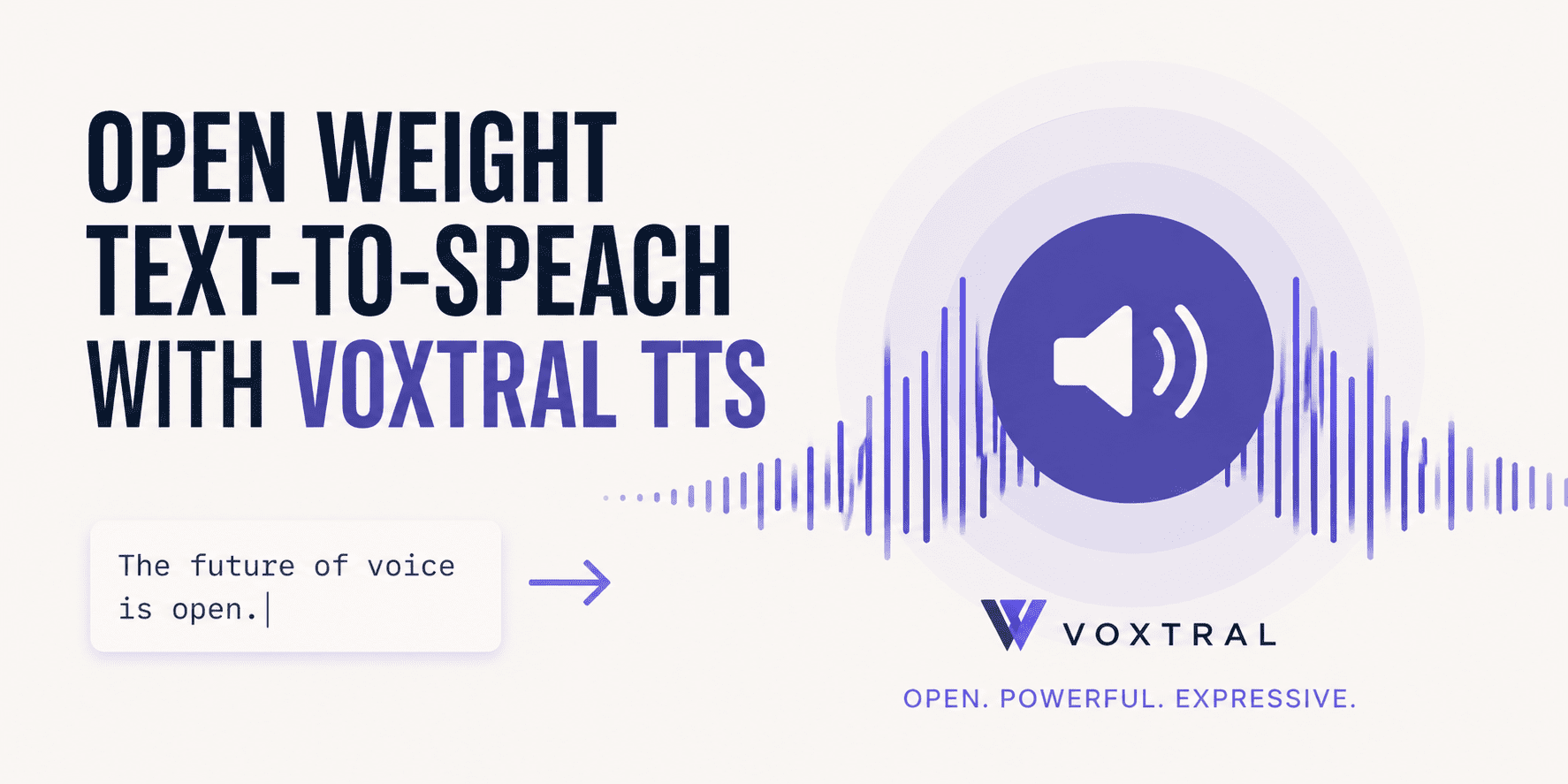
Introducing Voxtral TTS: Local, Low-Latency Voice Synthesis
Voxtral TTS by Mistral AI stands out by running fully on local consumer hardware, sidestepping the usual reliance on cloud servers. This shift isn’t just about convenience; it slashes latency to roughly 70 milliseconds, a crucial threshold for real-time applications such as conversational agents and gaming voiceovers. Supporting nine languages and capable of cloning voices from just three seconds of audio, Voxtral pushes the envelope in rapid, personalized speech generation.
The open-weight release for non-commercial use offers engineers transparency and flexibility but also surfaces questions around maintenance, security, and misuse potential. By removing cloud dependency, users gain full control over their data and reduce infrastructure costs, yet this autonomy shifts the burden of hardware performance and model updates onto end users. Delivering enterprise-grade quality locally challenges established deployment norms, warranting a closer look at how performance holds up across diverse devices and what trade-offs emerge.
Performance Highlights and Language Support
Voxtral TTS launches with a focus on delivering enterprise-level text-to-speech directly on consumer hardware. It covers nine languages—English, French, German, Spanish, Italian, Portuguese, Dutch, Russian, and Chinese—addressing a wide global audience. This multilingual scope is essential for applications ranging from localized content creation to international customer service bots.
Its real-time voice cloning is striking: only three seconds of audio input are needed to generate a convincing synthetic voice. This rapid adaptation outpaces many TTS systems that require longer samples or extensive training. The system’s latency hovers around 70 milliseconds, enabling near-instantaneous speech synthesis. Such responsiveness is critical for interactive uses like virtual assistants or gaming, where delays can disrupt user experience.
Since Mistral AI’s early 2024 announcement, the open-weight model has been available for non-commercial use, inviting developers and researchers to experiment without steep costs. Commercial users can access a supported API, balancing openness with scalable integration.
Benchmarks show Voxtral outperforming several competitors in naturalness and expressiveness. Listening tests highlight smoother prosody and more nuanced intonation, enhancing the human-like quality of the output. Still, challenges remain in handling complex code-switching and idiomatic expressions, signaling areas needing refinement.
Voxtral’s blend of broad language support, real-time cloning, and low latency marks a notable advance in local TTS technology. Yet, open weights and local execution also raise concerns about quality consistency across hardware and voice spoofing risks. These deserve careful scrutiny as adoption grows.
Potential Risks and Technical Challenges
The promise of local, low-latency voice synthesis with Voxtral TTS comes with technical and operational complexities. Running advanced neural TTS models on consumer-grade hardware demands balancing model sophistication against resource limits. The reported 70ms latency likely depends heavily on device specifics and optimization. Variations in CPU architecture, memory speed, and thermal constraints could cause inconsistent performance, especially on older or budget devices.
Making open weights available for non-commercial use fosters experimentation but also opens doors to misuse and complicates intellectual property control. The ability to clone voices from just three seconds of audio is impressive yet raises privacy and security red flags. Without centralized oversight, local execution could be exploited for impersonation or fraud.
Although nine languages are supported, this remains limited for truly global reach. Capturing dialectal differences, prosody subtleties, and cultural context in TTS systems is notoriously difficult. Sparse details on Voxtral’s training data and architecture leave questions about bias, robustness, and performance in noisy or diverse speech environments.
The API integration promises ease for developers, but embedding a heavy neural TTS engine into existing pipelines may require significant adaptation. Memory use, power consumption, and real-time responsiveness need validation beyond benchmarks. The split between open weights for non-commercial use and commercial API access risks ecosystem fragmentation, complicating deployment and licensing.
Voxtral TTS introduces technical innovation, but practical deployment depends on navigating hardware variability, ethical concerns around voice cloning, and linguistic diversity challenges. These factors require thorough evaluation before broad industrial or consumer rollout.
What This Means for Developers and Users
Voxtral TTS’s local, low-latency approach shifts the landscape for developers and users but brings trade-offs. Running entirely on-device eliminates cloud dependencies and many data privacy concerns common in AI speech tools. For developers, this means greater control over user data and the ability to deploy voice features offline or in restricted environments—an advantage for compliance and accessibility.
However, local execution demands capable hardware. Despite Voxtral’s efficiency, sufficient processing power and memory remain prerequisites, potentially excluding lower-end devices or forcing compromises in quality or speed. Developers must weigh these trade-offs carefully when targeting diverse hardware. The open weights encourage experimentation but commercial use involves navigating licensing and support complexities that could create friction.
The 70ms latency figure is impressive, enabling near-instant voice feedback that enhances interactive applications like gaming or assistants. Still, real-world performance depends on integration quality and deployment complexity. Developers should rigorously test under realistic conditions to avoid surprises.
From a user perspective, voice cloning from minimal audio input unlocks personalization but raises ethical and security concerns. Robust safeguards against spoofing and unauthorized replication are essential. Companies deploying Voxtral-driven features will need detection tools and clear consent protocols.
In practice, Voxtral TTS offers a powerful toolkit for advancing voice-driven interfaces without cloud overhead. Yet, realizing its benefits requires managing hardware limits, licensing nuances, and security risks. Engineers and product teams must understand these factors upfront to harness Voxtral’s potential without stumbling over hidden pitfalls.