Octopuses Use Mirrors to Find Hidden Food

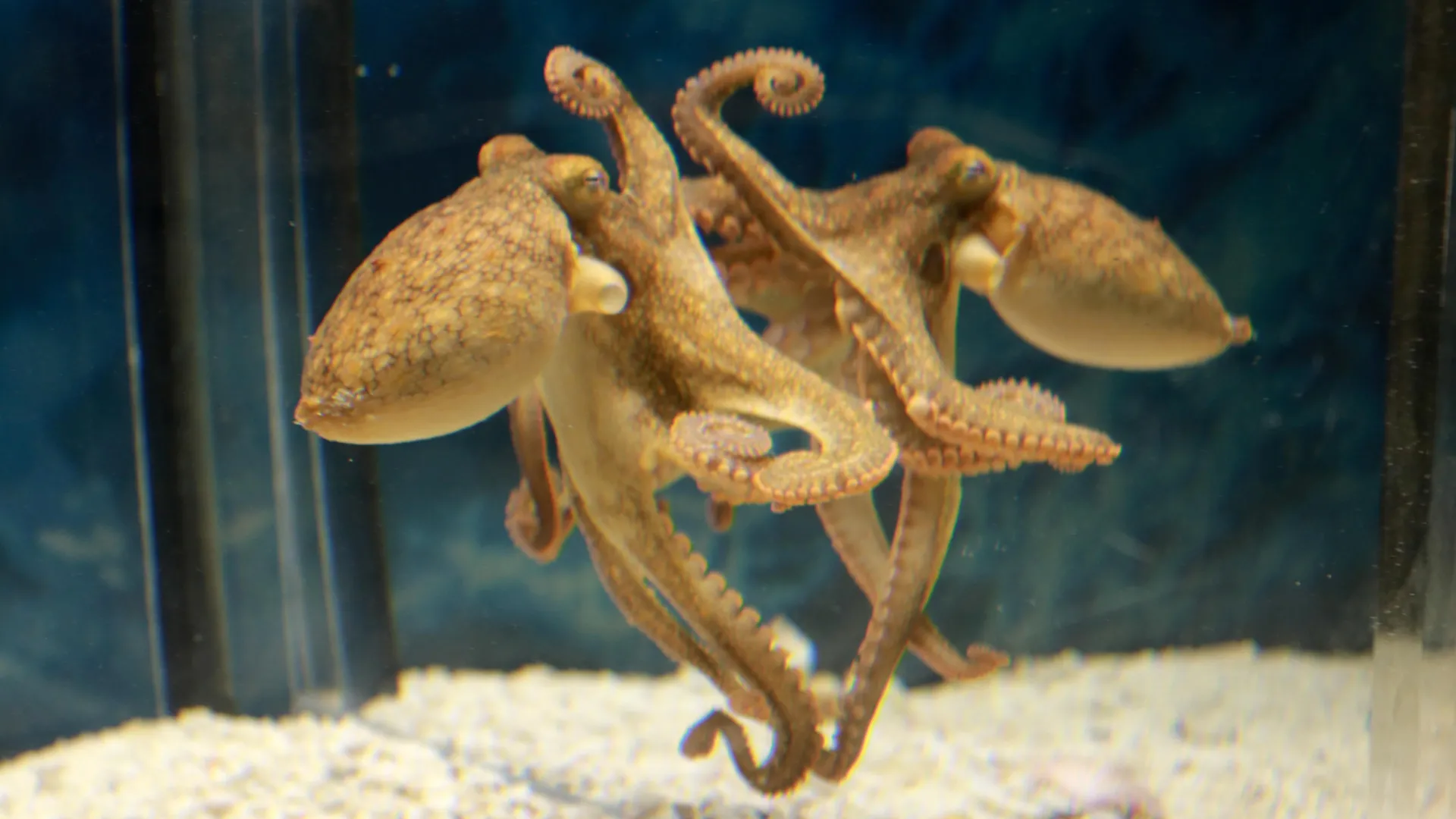
Dartmouth researchers have shown that California two-spot octopuses can use mirrors to find hidden food with about 73% accuracy. This goes beyond the usual mirror tests, which mostly focus on self-recognition in vertebrates. Instead, these octopuses interpret the mirror’s reflection as a spatial cue, effectively using it to map their surroundings and locate prey. This discovery challenges long-standing assumptions about invertebrate cognition. Octopuses aren’t just reacting to their image—they’re processing spatial information in a way that hints at advanced mental mapping. It’s a striking example of intelligence evolving independently in a radically different brain structure.

Spatial Cognition in Two-Spot Octopuses

Researchers at Dartmouth College designed experiments to test spatial awareness in California two-spot octopuses. They placed food items in spots visible only through a mirror and observed whether the octopuses could use the reflection to find the hidden treats. Over multiple trials, the octopuses located the food with roughly 73% accuracy—well above chance. This ability to interpret mirror reflections as spatial cues rather than mere images departs from earlier assumptions. Past studies mostly focused on vertebrates, where mirror use linked to self-recognition or simple reactions. Here, octopuses showed they can mentally map their environment using indirect visual information. These findings suggest octopuses possess advanced spatial cognition, likely aiding their complex hunting in dynamic underwater habitats. Mental mapping helps them navigate and exploit surroundings efficiently. Given octopuses diverged from vertebrates hundreds of millions of years ago, their skills suggest convergent evolution of intelligence. This evidence challenges the idea that invertebrates lack sophisticated mental processes. It opens new paths for studying how diverse species develop complex cognition despite very different neural architectures. The research invites a fresh look at the cognitive lives of creatures often overlooked in intelligence studies.

Rethinking Animal Intelligence Beyond Vertebrates

Octopuses have long intrigued scientists with their problem-solving and adaptability. Complex cognition traditionally linked mostly to vertebrates—mammals, birds, some fish. Invertebrates like octopuses were seen as more reflex-driven, guided by instinct rather than flexible mental processes. Recent work is changing that view. The California two-spot octopus (Octopus bimaculoides) now anchors new research. These animals navigate intricate underwater environments, hunt cleverly, and use tools. But their ability to understand spatial relationships through indirect cues—like reflections—hadn’t been conclusively shown before. Mirror tests have long probed self-awareness and spatial cognition, mainly in vertebrates. When an animal uses a mirror not just to react to its image but to locate hidden objects, it suggests mental mapping beyond simple recognition. Dartmouth’s study is the first to show octopuses using mirrors this way, with about 73% accuracy finding concealed food. This pushes the boundary of what counts as “intelligent” behavior in animals without backbones. It suggests octopuses form mental representations of surroundings and manipulate these internal maps to solve problems. Since octopuses split from vertebrates hundreds of millions of years ago, their cognition hints at convergent evolution—different paths reaching similar solutions. Understanding octopus intelligence reshapes research on invertebrate cognition. It raises questions about neural architecture and behavioral complexity in species long underestimated. This isn’t just curiosity about a clever sea creature—it demands rethinking the roots and diversity of intelligence across animals.

What This Means for Understanding Invertebrate Minds

These findings alter views on invertebrate intelligence, especially in octopuses long seen as instinct-driven. Researchers must expand experiments beyond vertebrates to species capable of spatial reasoning. This could speed discoveries about neural systems supporting advanced cognition across distant evolutionary lines. Practically, marine biology fields—like aquaculture and conservation—may need to rethink how they treat octopuses. Recognizing their spatial awareness and problem-solving could affect habitat design, enrichment, and welfare standards. It also raises ethical questions about their treatment in captivity and research. Policy makers could face pressure to update protections for invertebrates, reflecting growing evidence intelligence isn’t exclusive to animals with backbones. This challenges regulatory frameworks that often exclude invertebrates from welfare considerations. For educators and the public, these insights enrich the story of animal minds. Octopuses can no longer be dismissed as simple creatures; their cognitive skills suggest a parallel intelligence evolved independently. This may shift how we relate to and respect non-vertebrate life.
Ссылка на первоисточник
The next chapter in flood resilience: Open sourcing Google’s hydrology framework
Science & Tech

AI Advances in Flood Forecasting

Google’s open-source AI hydrology framework offers customizable flood forecasting powered by LSTM networks. Validated with Czech data, it b…