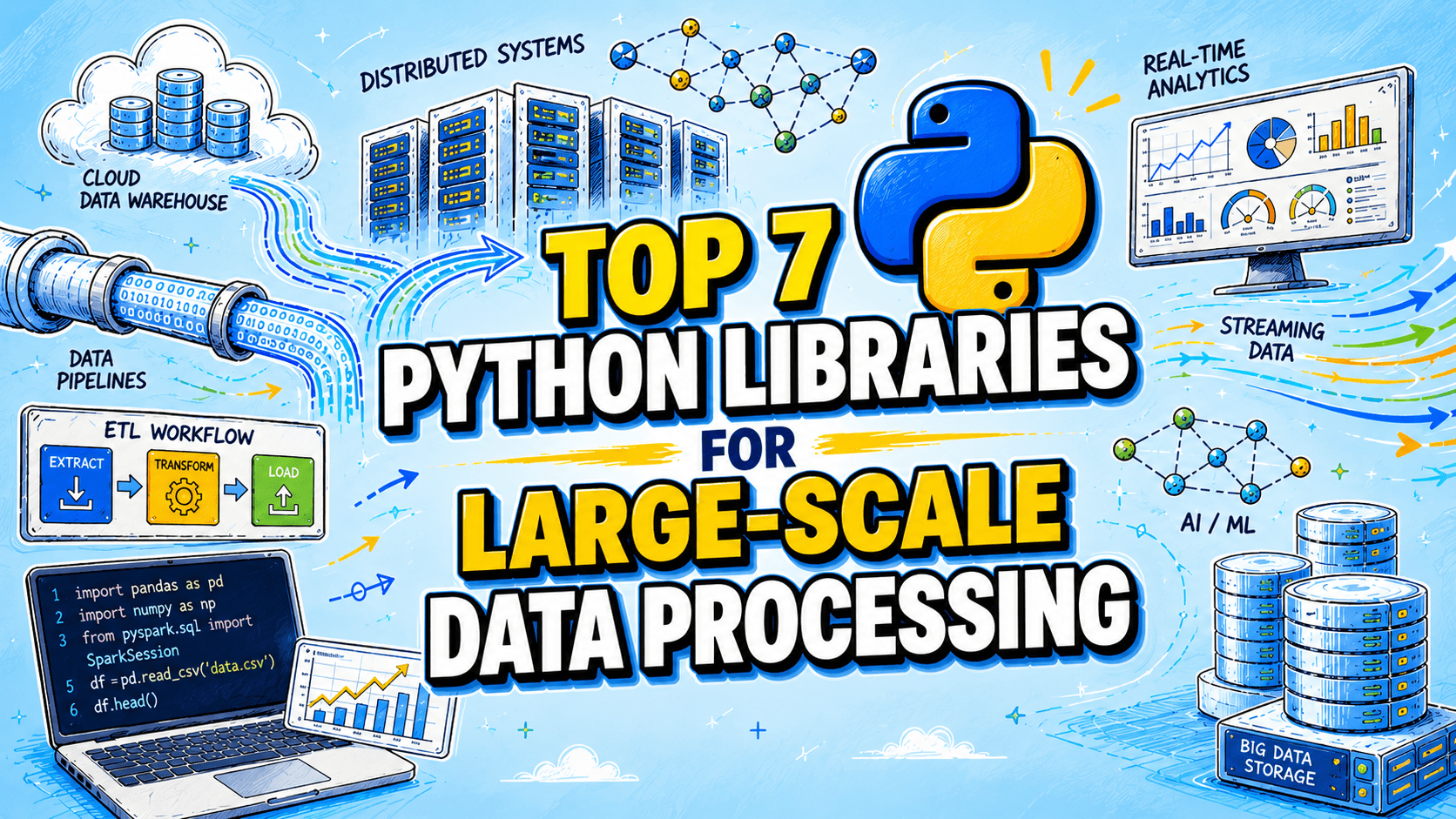
Python Libraries Tackling Big Data Challenges

Python’s big data landscape is shifting fast. PySpark still dominates for distributing workloads across clusters, taming datasets too large for one machine. But it’s no longer the only game in town. Dask extends pandas and NumPy workflows beyond memory limits, offering parallel and distributed computing without the complexity of full cluster setups. Polars is carving out a niche with lightning-fast DataFrame operations and lazy evaluation, making data manipulation both efficient and flexible. These tools don’t just handle volume—they rethink how Python manages memory and computation, addressing bottlenecks that have frustrated analysts for years. Libraries like Ray, Vaex, Kafka, and DuckDB add more options, each targeting specific challenges from real-time streaming to in-process analytics. The key isn’t one-size-fits-all; it’s about matching the right tool to the data problem at hand.

Seven Tools Reshaping Large-Scale Data Processing

PySpark remains a cornerstone for distributed data processing. Built on Apache Spark, it runs computations across clusters, handling petabytes spread over multiple nodes. Since its early 2010s debut, PySpark has improved APIs and cloud integration, cementing its role in enterprise big data. Dask picks up where pandas and NumPy hit memory ceilings. It extends familiar data structures to run in parallel or distributed modes, whether on a laptop or a cluster. By chunking data and dynamically scheduling tasks, Dask scales smoothly without rewriting codebases. Polars takes a fresh approach with a Rust engine powering high-performance DataFrame operations. Its lazy evaluation defers computation until needed, optimizing query plans and cutting resource use. Polars is gaining fans for speed and memory efficiency, especially when rapid data manipulation is critical. Ray targets distributed machine learning and parallel execution. It abstracts scaling Python code across cores or nodes, supporting tasks from model training to hyperparameter tuning. Its modular ecosystem makes it a flexible choice for AI teams needing scalable compute without losing Python’s simplicity. Vaex specializes in out-of-core analysis on single machines. It memory-maps files and applies efficient algorithms, letting users explore billions of rows interactively without loading everything into RAM. This appeals to researchers working with massive datasets but limited infrastructure. Apache Kafka stands apart as a real-time streaming platform. It reliably handles high-throughput data streams with low latency, powering systems that require immediate insight or action—think fraud detection or monitoring. DuckDB offers an in-process SQL analytics engine for ad hoc queries on local files. Supporting formats like Parquet and CSV without a separate server, DuckDB simplifies analytics workflows with a lightweight footprint and embedded SQL compatibility. Together, these seven tools form a diverse toolkit addressing different facets of large-scale data challenges. They shift the focus from monolithic systems to flexible, composable solutions tailored to specific workloads and environments.

How These Libraries Fit Into Modern Data Workflows

Data workflows today rarely rely on a single tool. Instead, they blend libraries to tackle scaling, memory, and real-time demands. PySpark thrives in distributed clusters, fitting organizations invested in big data ecosystems like Hadoop. Dask extends pandas and NumPy patterns beyond single-machine memory limits, letting analysts scale without full rewrites. Polars offers speed and flexibility through efficient DataFrame operations and lazy evaluation. Ray orchestrates distributed machine learning, integrating parallelism into Python scripts. Vaex enables out-of-core analysis, handling datasets too large for RAM without cluster overhead. Kafka powers real-time pipelines with fault-tolerant streaming, feeding downstream analytics instantly. DuckDB embeds SQL analytics directly on files, perfect for quick queries without spinning up a database server. These libraries slot into pipelines based on scale, latency, and resource needs. They often complement rather than replace each other. Knowing their roles helps data teams balance speed, cost, and complexity without overcommitting to any single approach.

What This Means for Data Engineers and Scientists

Data volumes and velocity don’t just push boundaries—they redraw them. PySpark and Dask unlock distributed processing but require solid knowledge of parallelism and cluster management. Without that, teams risk bottlenecks or wasted resources. Memory management moves front and center. Polars and Vaex offer lazy evaluation and out-of-core computation, handling massive datasets on modest hardware. But integrating them demands rethinking ingestion and transformation strategies. Real-time processing with Kafka shifts architectures toward continuous, event-driven models. This requires new monitoring, fault tolerance, and scaling methods. Ray’s parallel execution adds complexity by enabling distributed machine learning, raising the bar for debugging and tuning. For data scientists, these tools speed iteration and expand dataset sizes. Yet, the abstractions are partial. Understanding infrastructure details remains crucial to optimize performance. Adopting these libraries means investing in skills. They expose the complexity of distributed systems and streaming data in ways that can challenge even experienced teams. Those who manage this balance can deliver insights faster and handle more complex problems without constant infrastructure churn. Still, the ecosystem is fragmented. Each library excels in niches, but stitching them into maintainable stacks is tricky. Data teams must choose carefully, build incrementally, and keep clear sight of data’s path from ingestion to insight.

Choosing the Right Library for Your Data Needs

Choosing the right Python library means matching your data needs to each tool’s strengths. Massive datasets on clusters? PySpark handles scale well but has setup overhead. Outgrowing pandas or NumPy memory? Dask scales smoothly without rewriting code. Speed and memory efficiency point to Polars with its lean DataFrame ops and lazy evaluation. Distributed machine learning or complex parallelism? Ray fits that niche. For single-machine analysis of large data, Vaex offers out-of-core capabilities without cluster complexity. Real-time streaming calls for Kafka’s robust event handling, though it demands infrastructure. DuckDB suits embedded SQL analytics on files without a separate server. No single library solves all problems. Often, combining tools makes sense—Dask with Ray or PySpark alongside Kafka. Consider data size, processing speed, memory, and real-time needs to avoid costly rewrites and keep pipelines efficient as demands grow.
Ссылка на первоисточник
The next chapter in flood resilience: Open sourcing Google’s hydrology framework
Science & Tech

AI Advances in Flood Forecasting

Google’s open-source AI hydrology framework offers customizable flood forecasting powered by LSTM networks. Validated with Czech data, it b…