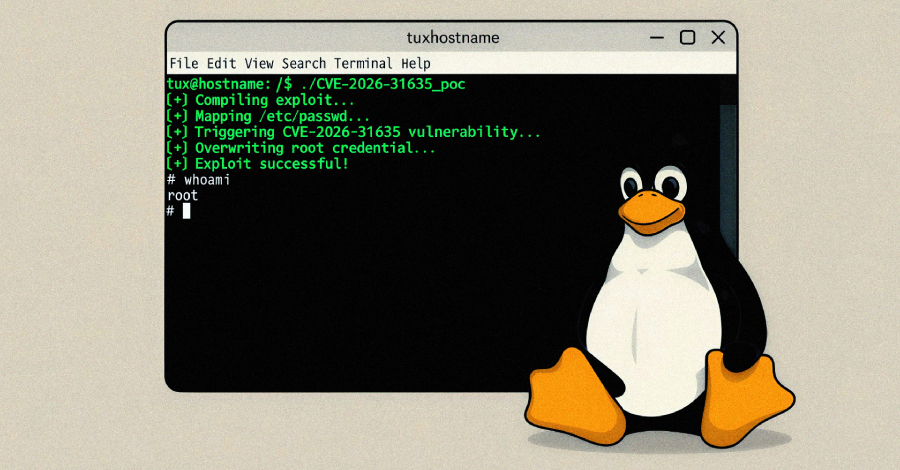
DirtyDecrypt PoC Exploits Linux Kernel Flaw

The DirtyDecrypt proof-of-concept exploit has landed, targeting a freshly patched flaw in the Linux kernel identified as CVE-2026-31635. This vulnerability hinges on a missing copy-on-write safeguard within the kernel’s decryption routine, specifically affecting systems compiled with the CONFIG_RXGK option enabled. Distributions like Fedora, Arch Linux, and openSUSE Tumbleweed are in the crosshairs. What makes DirtyDecrypt particularly dangerous is its ability to elevate local user privileges by manipulating privileged file data through this kernel weakness. Attackers with local access can exploit this to gain root-level control, bypassing standard security barriers. The release of a working PoC now puts immediate pressure on administrators and developers alike to reassess their defenses and patch deployments.

Vulnerability Details and Affected Systems

The DirtyDecrypt exploit targets a vulnerability tracked as CVE-2026-31635 in the Linux kernel. It hinges on a missing copy-on-write (COW) guard within the kernel’s decryption routine. This gap allows local users to escalate privileges by manipulating decrypted memory regions that should otherwise be protected. Specifically, the flaw resides in kernel configurations that enable `CONFIG_RXGK`. This setting is present in several popular distributions, including Fedora, Arch Linux, and openSUSE Tumbleweed. The vulnerability lets attackers alter privileged file data, potentially gaining root-level access without leaving obvious traces. The proof-of-concept (PoC) code surfaced in early May 2026, shortly after the kernel patch was released. Its public availability raised alarms because it demonstrated a straightforward path to exploitation on unpatched systems. The exploit abuses the failure to enforce COW semantics during decryption, which is critical for maintaining memory isolation. Linux developers have responded swiftly. Initial patches aim to close the COW gap, but discussions are underway about introducing emergency “killswitches” to disable the affected decryption function entirely if necessary. This reflects the kernel community’s cautious approach—prioritizing system stability while mitigating risk. Distributions like Rocky Linux have begun integrating these patches into their updates, encouraging users to apply them promptly. Still, the presence of this vulnerability underscores persistent challenges in kernel memory management and cryptographic safeguards. It’s a reminder that even mature components like the Linux kernel require constant scrutiny and rapid response to evolving threats.

Kernel Memory and Crypto Risks Persist

Kernel memory handling has always been a tricky area for Linux security. The DirtyDecrypt exploit zeroes in on a subtle but critical oversight: a missing copy-on-write check during kernel decryption routines. This lapse lets local attackers escalate privileges by corrupting memory regions that should be off-limits. The flaw isn’t an isolated glitch but part of a pattern exposing how kernel cryptographic operations remain a fragile attack surface. Linux distributions that enable certain kernel features—like `CONFIG_RXGK`—find themselves particularly exposed. Fedora, Arch Linux, and openSUSE Tumbleweed are among those impacted. The vulnerability allows attackers to manipulate decrypted file data, effectively rewriting memory that should be protected. That’s a direct path to root-level control without needing remote access. This isn’t the first time kernel memory management has faltered under cryptographic workloads. Past vulnerabilities have similarly exploited race conditions or bypassed memory isolation. The kernel’s complexity and performance demands often make these subtle bugs hard to detect before release. Cryptographic code, in particular, must juggle efficiency and security, leaving room for errors that attackers can exploit. Developers have patched CVE-2026-31635 swiftly, but the emergence of DirtyDecrypt’s proof-of-concept underscores that kernel crypto code needs ongoing scrutiny. Defensive strategies now include emergency toggles to disable risky kernel functions temporarily. Still, the fundamental challenge remains: how to balance kernel performance with airtight memory protections in cryptographic paths. For users and admins, the takeaway is clear. Keeping kernels up to date is critical, but so is understanding that kernel-level crypto risks are persistent. This vulnerability is a reminder that even mature, widely used components like Linux’s kernel crypto subsystems can harbor dangerous flaws—ones that attackers will keep probing until defenses catch up.

Developer Responses and Security Measures

The DirtyDecrypt exploit has jolted Linux kernel developers into swift action. Beyond the usual patch releases, discussions are underway about deploying emergency "killswitches" to disable the vulnerable decryption paths entirely until users can update safely. This signals a growing recognition that reactive patches alone may not suffice against exploits targeting low-level kernel components. Distributions like Rocky Linux and Fedora have accelerated their update cycles, pushing out fixes and advisories with unusual urgency. But the challenge remains: many systems run kernels compiled with the problematic `CONFIG_RXGK` feature enabled by default, often without users’ explicit knowledge. This raises questions about how distributions balance enabling advanced features against the increased attack surface they create. For system administrators, the stakes are clear. The exploit allows local privilege escalation, meaning a compromised user account could pivot to full root access. This elevates the risk profile for any multi-user environment, especially cloud servers or containers where kernel vulnerabilities can cascade into broader breaches. From a security operations perspective, the incident underscores the need for layered defenses. Kernel hardening tools, strict access controls, and vigilant patch management must work in concert. The Linux kernel’s complexity and its central role make it a persistent target, so developers and operators alike must treat such vulnerabilities as systemic risks, not isolated bugs. The move toward emergency mitigations also reflects a subtle shift in developer mindset. Rather than waiting for comprehensive patches, temporarily disabling risky features could become a standard stopgap. This approach might frustrate users who rely on certain kernel functionalities, but it prioritizes containment over convenience—a trade-off increasingly accepted in security circles. All told, DirtyDecrypt is a reminder that kernel-level security remains a moving target. The ongoing dialogue among developers, distribution maintainers, and users will shape how resilient Linux becomes against future exploits that probe the kernel’s cryptographic and memory management layers.

Urgent Patch Application and Monitoring

The immediate priority for system administrators is to verify that the patch for CVE-2026-31635 is applied without delay. Despite the official fix, the release of a working DirtyDecrypt proof-of-concept means attackers now have a clear blueprint to exploit unpatched systems. This elevates the risk profile, especially on distributions like Fedora, Arch Linux, and openSUSE Tumbleweed where `CONFIG_RXGK` remains enabled by default. Beyond patching, monitoring kernel logs for unusual activity tied to cryptographic operations or suspicious memory access patterns will be critical. The kernel’s complex handling of copy-on-write and decryption routines has proven a recurring attack surface, so vigilance must remain high. Developers’ discussions about emergency disables for the affected functions suggest the vulnerability’s root causes are not trivial to eradicate. This hints at potential follow-up advisories or incremental hardening patches in the near term. Watch also for updates from major distributions. Some, like Rocky Linux, are already experimenting with temporary workarounds that could influence how others respond. Any new mitigations that affect kernel modules or cryptographic subsystems will need careful testing to avoid disrupting legitimate workloads. The bigger question is whether this incident will accelerate deeper architectural changes to kernel memory safeguards. DirtyDecrypt exposes how subtle flaws in copy-on-write enforcement can lead to privilege escalation, an issue with no quick fix in the existing kernel design. For now, the best defense remains prompt patching combined with active monitoring. The kernel community’s next moves will reveal how seriously these systemic risks are being addressed beyond reactive patches.
Ссылка на первоисточник
Polypad – The Mathematical Playground
Cybersecurity

Math Learning Tools Digest

Polypad is a free, browser-based platform offering customizable virtual math manipulatives like fraction bars, 3D polyhedra, and logic gate…