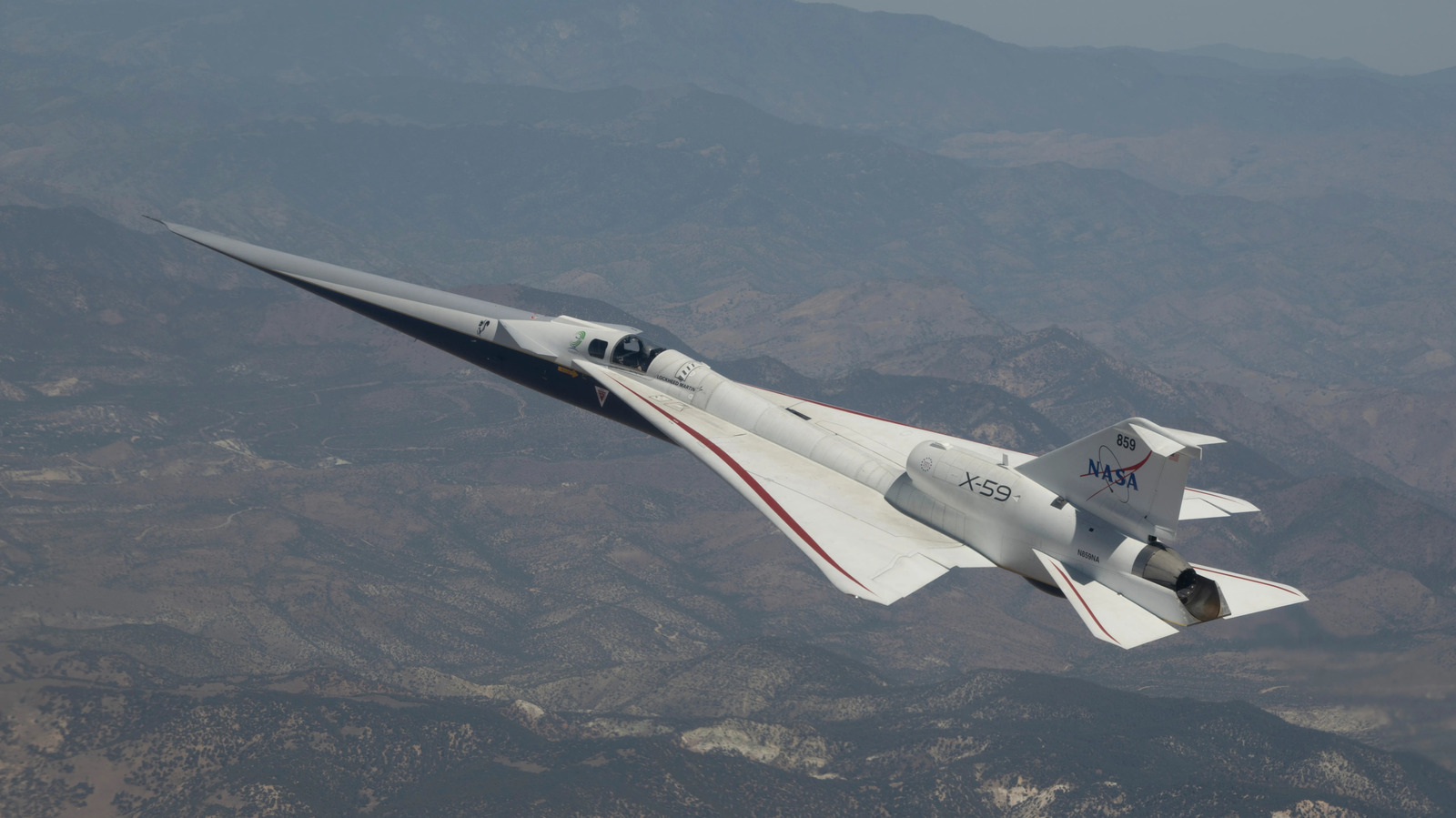
NASA's Quiet Supersonic Flight Set for Early June
NASA’s X-59 is gearing up for its inaugural supersonic flight, slated for early June. The experimental aircraft aims to cruise beyond 630 mph while drastically cutting the sonic boom to a barely perceptible thump. This project isn’t just about speed; it’s about rewriting the noise rules that have long restricted commercial supersonic travel over land.
The technical challenge is steep. Quiet supersonic flight demands precise aerodynamic shaping and advanced materials to manage shockwave patterns. Success here could unlock new corridors for supersonic jets, but the X-59’s upcoming test will be the first real proof point. The stakes are high—any miscalculations in noise reduction or flight stability could stall regulatory acceptance and commercial viability. For now, all eyes are on this quietly ambitious leap forward.
FAA Grounds SpaceX Starship After Booster Issues
SpaceX’s Starship program hit a significant snag when the Federal Aviation Administration (FAA) imposed a grounding order following the latest test flight of the Super Heavy booster. The incident occurred during the boostback burn phase, critical for returning the booster safely to the launch site. Engine anomalies led to a hard splashdown in the ocean, deviating from the expected controlled descent. This failure triggered an FAA investigation focused on verifying compliance with safety regulations and assessing risks to public safety.
The grounding is not unprecedented in the context of SpaceX’s rapid, iterative testing model, but it does underscore persistent technical challenges in scaling up reusable heavy-lift launch vehicles. The Super Heavy booster, designed to power the Starship stack into orbit, relies on complex engine coordination and precision flight control. The recent malfunction raises questions about engine reliability and the robustness of the flight termination and recovery systems under real-world conditions.
FAA’s cautious stance reflects the agency’s mandate to mitigate hazards posed by experimental flights, especially as Starship operations approach higher flight rates and more ambitious missions. SpaceX will need to provide detailed anomaly reports and demonstrate corrective measures before clearance to resume. This pause serves as a reminder that despite progress, the path to operational readiness for next-generation launch systems remains fraught with technical uncertainties that demand rigorous scrutiny.
Technical Challenges Behind Recent Aerospace Setbacks
The recent aerospace setbacks underscore persistent technical vulnerabilities that often remain hidden beneath headlines of progress. Take NASA’s X-59: while its planned supersonic flight aims to demonstrate quieter sonic booms, the challenge lies not just in hitting 630 mph but in validating noise reduction under varied atmospheric conditions. Acoustic measurements are notoriously sensitive to environmental variables; a single test flight may not capture the full operational envelope needed for regulatory confidence. This introduces uncertainty about how soon such technology can realistically transition from experimental to commercial use.
Meanwhile, SpaceX’s Starship grounding reveals deeper systemic risks tied to rapid iteration in rocket development. The Super Heavy booster’s engine anomalies during boostback burn highlight the fragility of complex propulsion systems operating at extreme thrust levels. Engine reliability under repeated thermal and mechanical stress remains a critical bottleneck. The FAA’s cautious stance reflects not only public safety concerns but also the difficulty of certifying vehicles that evolve through frequent design changes and unconventional testing methods. This raises questions about the scalability of SpaceX’s approach when moving toward routine orbital launches.
Blue Origin’s New Glenn also illustrates the tension between ambitious timelines and unproven hardware readiness. Delays and technical hurdles with its first-stage engines suggest that even well-funded programs face intricate integration challenges. Engine performance consistency, structural integrity under dynamic loads, and seamless coordination between stages are non-trivial engineering feats. These factors collectively temper expectations for near-term breakthroughs in heavy-lift capability.
Taken together, these developments expose a landscape where aerospace innovation is as much about managing incremental technical risks as it is about headline-grabbing milestones. The interplay between experimental designs, regulatory scrutiny, and operational safety creates a complex matrix of constraints that no single test flight or prototype can fully resolve. It’s a reminder that progress in aerospace remains a careful balancing act—one that demands patience, rigorous validation, and a sober acknowledgment of the unknowns still in play.
What These Developments Mean for Aerospace Innovation
The latest aerospace shifts underscore a complex reality: innovation in this sector is far from linear progress. NASA’s X-59 is pushing the envelope on quiet supersonic travel, aiming to tame the noise barrier that has long limited commercial supersonic flight. If successful, it could reshape regulations and open new routes for faster-than-sound travel. Yet, this promise rides on unproven technology and delicate engineering feats—any misstep could delay or derail the broader adoption of supersonic jets.
Meanwhile, SpaceX’s Starship setbacks reveal the inherent volatility of rapid iterative testing. The FAA’s grounding after the Super Heavy booster’s engine failure highlights how safety remains a non-negotiable constraint, even amid aggressive development timelines. The hard splashdown and engine anomalies remind us that scaling up rocket technology involves navigating unpredictable failure modes. Each grounded flight is a data point, but also a caution: rushing to operational status without exhaustive validation risks both hardware and public trust.
Blue Origin’s ongoing challenges with New Glenn further illustrate that even well-funded, experienced players face steep technical hurdles. Achieving reliable, reusable heavy-lift rockets demands mastering complex propulsion and structural systems, where minor flaws can cascade into mission-critical failures.
Taken together, these developments reflect an aerospace landscape where ambition collides with engineering reality. Progress hinges not just on breakthroughs, but on meticulous risk management and incremental learning from failure. For engineers and policymakers alike, the takeaway is clear: embracing innovation requires patience and rigorous safety oversight. The path to next-generation aerospace capabilities will be uneven, but measured caution will ultimately safeguard both technological gains and public confidence.