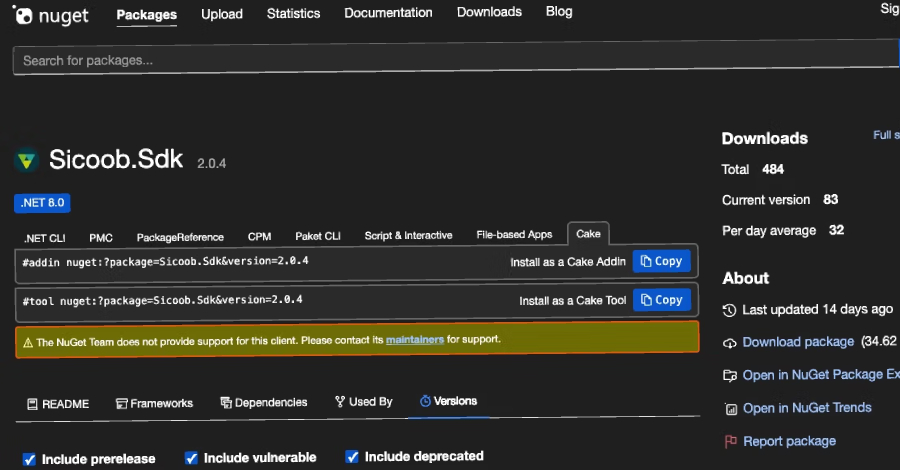
Malicious NuGet Package Targets Brazil's Sicoob Bank
A counterfeit NuGet package masquerading as the official SDK for Brazil’s Sicoob bank surfaced recently, with a clear and dangerous intent: to siphon off sensitive banking credentials. Named “Sicoob.Sdk,” this malicious library was crafted to harvest PFX certificates and client IDs—critical assets that grant deep access to banking operations. Developers integrating this package unwittingly exposed their systems, enabling attackers to automate fraudulent transactions with alarming efficiency.
The package slipped into the NuGet repository unnoticed for a brief window, accumulating roughly 500 downloads before researchers flagged and triggered its removal. This incident underscores a growing trend of supply chain attacks targeting trusted development ecosystems like NuGet and npm. The deceptive naming and close imitation of legitimate SDKs amplify the risk, especially for developers who rely on automated package management without rigorous vetting. With financial credentials at stake, the stakes here extend beyond typical malware—this is a precision strike aimed at undermining trust in software dependencies.
How the 'Sicoob.Sdk' Package Steals Credentials
The “Sicoob.Sdk” package masqueraded as an official software development kit for Brazil’s Sicoob banking system but concealed malicious code engineered to harvest critical credentials. Once developers integrated this package, it executed routines to extract PFX certificates stored on the local machine. These certificates are essential for authenticating users to banking services, making their theft a direct conduit to unauthorized access.
In addition to certificates, the package targeted client IDs—unique identifiers that facilitate API interactions with the bank’s systems. By capturing these alongside the certificates, attackers could automate fraudulent transactions or data exfiltration under the guise of legitimate users.
The malicious behavior triggered silently during normal package usage, reducing suspicion. It operated by scanning typical file paths for certificate stores and intercepting authentication tokens as they were loaded into memory. This approach exploited the trust developers place in third-party libraries, weaponizing that trust to breach security boundaries.
The package was first published in early May 2026, accumulating roughly 500 downloads before security researchers flagged its suspicious activity. Following responsible disclosure, the NuGet repository swiftly removed it. However, the attack underscores how supply chain compromises can slip through standard vetting, especially when threat actors mimic widely used SDKs tied to financial institutions.
This incident reveals a layered attack strategy: impersonation to gain initial foothold, credential harvesting for persistent access, and automation to scale fraudulent operations. Developers relying on external packages must therefore scrutinize sources meticulously and monitor for anomalous behaviors that could indicate such covert intrusions.
Understanding the Supply Chain Threat Landscape
Supply chain attacks like the “Sicoob.Sdk” incident expose a persistent tension in software ecosystems: how to balance rapid development and dependency reuse against security vetting. NuGet’s automated package indexing and minimal publisher verification ease adoption but create openings for malicious actors. While this attack targeted a niche banking SDK with a relatively low download count, it underscores how even specialized packages can be weaponized to harvest high-value credentials.
One should be cautious about extrapolating the scale or impact solely from download metrics. Attackers often rely on stealth and targeted deployment rather than mass infection. The presence of PFX certificate theft signals a sophisticated adversary with knowledge of cryptographic assets’ value, but the exact downstream impact depends heavily on the victim’s environment and mitigation controls. For instance, organizations using hardware security modules (HSMs) or strict key lifecycle management may limit damage despite credential compromise.
Moreover, the detection and removal of this package after roughly 500 downloads highlight a reactive posture in current supply chain defenses. Automated scanning tools and manual audits remain imperfect, especially when attackers mimic legitimate package naming conventions and embed malicious code in obfuscated ways. This raises questions about how package repositories can evolve verification processes without stifling developer agility.
Finally, while this case focuses on NuGet and a Brazilian banking context, the broader supply chain threat landscape is complex and multifaceted. Attackers exploit trust relationships, human error, and inadequate monitoring across diverse ecosystems—not just the most popular package managers. Developers and security teams must therefore maintain a layered defense strategy, combining dependency analysis, runtime anomaly detection, and rigorous credential management to navigate these evolving risks.
Steps Developers Should Take Now
Developers need to act quickly and deliberately to avoid falling victim to this kind of supply chain threat. First, always verify the source of any SDK or package before integrating it into your projects. Check the publisher’s identity, review the package’s metadata closely, and avoid installing packages with names that mimic trusted libraries but come from unverified authors. Relying solely on package popularity or download counts can be misleading, as this incident shows.
Next, implement strict dependency auditing tools that flag suspicious packages or unexpected updates. Automated scans should go beyond surface-level checks and incorporate behavioral analysis where possible, looking for code that accesses sensitive files or environment variables. Continuous monitoring of your build pipelines for anomalies can catch malicious insertions early.
Credential management practices must also tighten. Avoid embedding sensitive keys or certificates directly in code. Use secure vaults or environment-based secrets management with limited access. If your project depends on certificates like PFX files, ensure they are stored and accessed securely, and consider rotating them regularly after any suspected compromise.
Finally, maintain a culture of vigilance. Educate your team about supply chain risks and encourage reporting of irregularities. The Sicoob.Sdk case underscores how attackers exploit trust and familiarity. Staying skeptical about dependencies and proactively verifying every component’s integrity is the best defense. The question isn’t just if your code is secure, but whether every piece you pull in from external sources can be trusted.

Global Digests News delivers timely, credible coverage of world affairs, politics, economy, and technology to keep you informed on today’s top stories.

Media Transparency in Defence Reporting
Nearly 60% of UK media reports on military issues fail to disclose contributors’ ties to the defence industry, risking biased narratives an…

TA4922’s Phishing Campaigns Go Global, Shift Tactics to Messaging Apps
TA4922, a financially motivated cybercrime group, has expanded phishing attacks from East Asia into Europe and Africa. Their evolving malwa…

DesckVB RAT Exploits Google’s DoubleClick Domain to Evade Detection
A new malspam campaign abuses Google’s DoubleClick domain to deliver the DesckVB RAT. By hijacking trusted ad URLs, attackers bypass filter…
Performance Optimization Through Memory Layout and Cache Efficiency
Organizing data as a Struct of Arrays (SoA) instead of an Array of Structs (AoS) can drastically improve cache utilization, enabling up to…

Security Digest: NTLMv2 Hash Theft via Windows Search URI Handler
A new Windows Search URI handler flaw lets attackers steal NTLMv2 hashes by tricking users into clicking malicious links. Microsoft refuses…

Security Digest: Oracle WebLogic Server Vulnerability (CVE-2024-21182)
Oracle WebLogic Server faces a critical flaw (CVE-2024-21182) allowing unauthenticated attackers full control. Despite a July 2024 patch, m…

Legal Dispute Between Adafruit Industries and Defy Gravity, Inc.
Adafruit Industries faced legal pressure from Defy Gravity, Inc. over an article on Flux.AI. The dispute centers on intellectual property c…

Cyber Espionage Alert: SideCopy Targets Afghan Ministry of Finance
The Pakistan-linked SideCopy group launched a spear-phishing attack against Afghanistan’s Ministry of Finance using a malicious LNK file to…