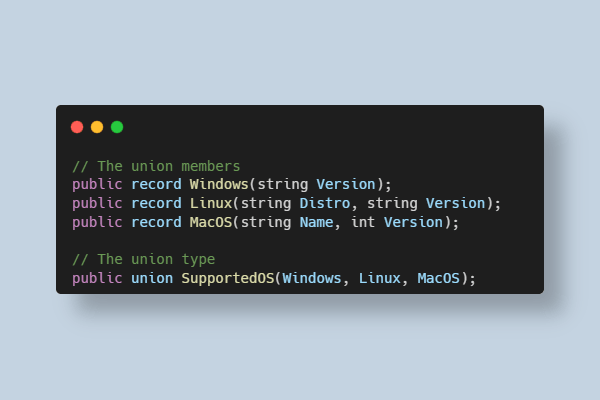
Introducing Native Union Types in C# 15
C# 15 in .NET 11 introduces native union types—a feature long familiar in functional languages like F# and Rust—finally bringing this powerful type system construct to mainstream C# development. This change isn’t just syntactic sugar; it allows variables to hold values from a defined set of distinct types, enhancing both expressiveness and compile-time type safety. Developers can now declare unions with a new union keyword and leverage exhaustive pattern matching without resorting to catch-all defaults, reducing runtime surprises.
Under the hood, unions are implemented as structs adorned with a [Union] attribute and conform to an IUnion interface. This design choice keeps the feature lightweight but introduces subtle trade-offs. For instance, value types inside unions get boxed, which can incur unexpected performance costs in high-throughput scenarios. The feature is still in preview, requiring explicit SDK and language feature flags, signaling that the runtime and tooling ecosystem are still catching up. The arrival of native union types marks a notable shift in C#’s type system, but it also demands careful consideration of when and how to adopt them without compromising performance or clarity.
How Union Types Work in .NET 11
Native union types arrive in .NET 11 through C# 15, introducing a distinct syntax and runtime behavior that departs from prior workarounds. Central to this feature is the new union keyword, which defines a type capable of holding one of several specified types at any given time. Unlike traditional inheritance or interface-based polymorphism, union types explicitly enumerate the permissible variants, enabling the compiler to enforce stricter type safety.
Under the hood, the compiler generates a struct annotated with a [Union] attribute, implementing an internal IUnion interface. This design choice aims to keep unions as lightweight as possible, avoiding reference types and heap allocations where feasible. However, when value types are included within a union, boxing occurs to accommodate the heterogeneous nature of stored values, introducing potential performance overhead. Developers must weigh this trade-off, especially in performance-critical paths.
Pattern matching support is a key part of the implementation. Union types integrate seamlessly with exhaustive switch expressions, allowing developers to handle each variant explicitly without resorting to catch-all default cases. This enhances code clarity and reduces runtime errors related to unhandled cases. The compiler’s ability to verify exhaustiveness at compile time is a notable advancement for C#’s type safety guarantees.
Adoption currently requires enabling preview language features and installing the latest .NET 11 SDK preview, reflecting the feature’s experimental status. This early stage means tooling and runtime support may evolve, and developers should monitor for changes impacting performance or compatibility.
Overall, the integration of native union types in .NET 11 marks a deliberate shift toward more expressive and precise type modeling. Yet, the nuances of boxing and struct-based implementation suggest that while union types simplify certain patterns, they also introduce complexity that demands careful consideration in system design.
Potential Challenges and Developer Considerations
The introduction of native union types in C# 15 undeniably expands the language’s expressive power, but it is not without trade-offs that warrant careful scrutiny. The underlying implementation hinges on structs adorned with a [Union] attribute and interfaces like IUnion, which, while elegant, introduce subtle complexities. For instance, the boxing of value types within unions can degrade performance, especially in tight loops or memory-sensitive contexts. Developers must weigh this overhead against the benefits of clearer type safety and pattern matching. The preview status of this feature compounds uncertainty—tools, IDE support, and runtime optimizations remain in flux, potentially causing friction in existing codebases or CI pipelines.
Moreover, the exhaustive pattern matching that union types enable depends heavily on compiler support to catch all cases at compile time. Yet, edge cases involving nested or recursive unions might escape full analysis, leaving runtime exceptions a possibility. This raises questions about how well union types integrate with legacy APIs or third-party libraries that expect single-type variables. Interoperability could become a sticking point without explicit guidance or bridging patterns.
Another subtle challenge lies in debugging and diagnostics. Since unions encapsulate multiple types under a single variable, tooling must evolve to present meaningful introspection and stack traces. Early adopters might face a steeper learning curve or produce harder-to-maintain code if these diagnostics lag behind language features.
Finally, the requirement to enable preview SDKs and language features means union types are not yet production-ready. Teams must plan for migration strategies, potential refactoring, and continuous monitoring of the feature’s evolution. The promise of union types is compelling, but their practical adoption demands a nuanced approach—balancing innovation with caution, and performance with maintainability.
What This Means for C# Developers
For developers, native union types in C# 15 offer a powerful new tool to express complex data scenarios with greater clarity and safety. Instead of juggling multiple nullable types or relying on inheritance hierarchies, you can now declare a variable that explicitly holds one of several predefined types. This reduces boilerplate and improves compiler checks, catching invalid states at compile time rather than runtime.
However, the implementation isn’t without trade-offs. The current boxing of value types inside unions can introduce unexpected allocations, potentially impacting performance-sensitive code. If your application demands tight memory or CPU constraints, you’ll need to profile carefully and consider whether union types fit your scenario or require custom optimizations.
Adopting union types also means embracing preview SDKs and language features for now, so production readiness remains a question mark. Still, the ability to write exhaustive pattern matches without default fallbacks can prevent subtle bugs and improve maintainability—an especially welcome benefit in large, complex codebases.
In short, union types bring C# closer to functional language expressiveness but ask developers to weigh improved type safety against performance and stability considerations. The feature’s true impact will depend on your project’s priorities and your willingness to experiment with evolving tooling.

Global Digests News delivers timely, credible coverage of world affairs, politics, economy, and technology to keep you informed on today’s top stories.

Media Transparency in Defence Reporting
Nearly 60% of UK media reports on military issues fail to disclose contributors’ ties to the defence industry, risking biased narratives an…

TA4922’s Phishing Campaigns Go Global, Shift Tactics to Messaging Apps
TA4922, a financially motivated cybercrime group, has expanded phishing attacks from East Asia into Europe and Africa. Their evolving malwa…

DesckVB RAT Exploits Google’s DoubleClick Domain to Evade Detection
A new malspam campaign abuses Google’s DoubleClick domain to deliver the DesckVB RAT. By hijacking trusted ad URLs, attackers bypass filter…
Performance Optimization Through Memory Layout and Cache Efficiency
Organizing data as a Struct of Arrays (SoA) instead of an Array of Structs (AoS) can drastically improve cache utilization, enabling up to…

Security Digest: NTLMv2 Hash Theft via Windows Search URI Handler
A new Windows Search URI handler flaw lets attackers steal NTLMv2 hashes by tricking users into clicking malicious links. Microsoft refuses…

Security Digest: Oracle WebLogic Server Vulnerability (CVE-2024-21182)
Oracle WebLogic Server faces a critical flaw (CVE-2024-21182) allowing unauthenticated attackers full control. Despite a July 2024 patch, m…

Legal Dispute Between Adafruit Industries and Defy Gravity, Inc.
Adafruit Industries faced legal pressure from Defy Gravity, Inc. over an article on Flux.AI. The dispute centers on intellectual property c…

Cyber Espionage Alert: SideCopy Targets Afghan Ministry of Finance
The Pakistan-linked SideCopy group launched a spear-phishing attack against Afghanistan’s Ministry of Finance using a malicious LNK file to…