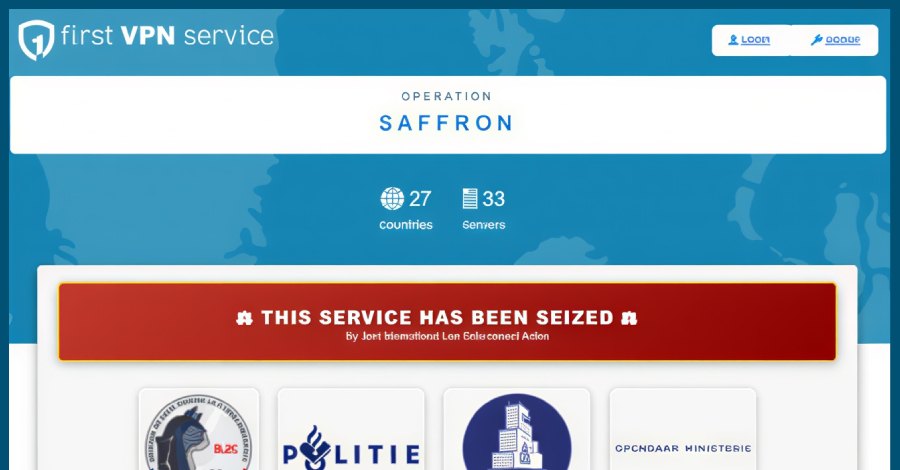
Inside Operation Saffron: The First VPN Takedown
Operation Saffron abruptly ended the decade-long run of "First VPN," a service that cloaked ransomware gangs’ digital footprints. Law enforcement from Europe and North America coordinated a swift strike, seizing 33 servers scattered across several countries and arresting the service’s operator. This wasn’t just another VPN shutdown—it hit a core enabler for at least 25 ransomware groups, cutting off a crucial layer of their anonymity.
"First VPN" had built a reputation on cybercrime forums, especially within Russian-speaking circles, where it openly marketed itself as a shield for illicit activity. Despite repeated efforts, the service never cooperated with authorities, making this takedown a rare and complex victory. The scale and precision of the operation reveal how seriously agencies now treat the infrastructure behind ransomware, not just the hackers themselves.
How Authorities Disrupted a Criminal VPN Network
The takedown of "First VPN" unfolded over several coordinated raids beginning in early May 2026. Law enforcement agencies from Europe and North America synchronized efforts to seize 33 servers spread across Germany, the Netherlands, Canada, and the United States. These servers formed the backbone of the VPN’s infrastructure, enabling it to route traffic through multiple jurisdictions and obscure user identities.
Investigators tracked the VPN’s operator through a combination of digital forensics and human intelligence. The administrator, a 34-year-old individual based in Eastern Europe, was apprehended at their residence following a warrant executed by local authorities. Notably, the suspect had maintained strict operational security, using encrypted communications and compartmentalized systems to avoid detection for over a decade.
The service’s infrastructure revealed sophisticated routing techniques designed to thwart tracing efforts. It employed multi-hop VPN chains and frequently rotated exit nodes. These features had made "First VPN" a favored tool among at least 25 ransomware groups, who relied on it to mask command-and-control servers and encrypt data exfiltration channels.
Despite persistent attempts by law enforcement to engage with the service’s operators, "First VPN" consistently refused cooperation, reinforcing its role as a criminal enabler rather than a legitimate privacy provider. The seizure of physical servers allowed authorities to confiscate logs and configuration files, delivering crucial intelligence on client connections and timing patterns.
This intelligence enabled further action against affiliated ransomware groups, linking specific attacks to VPN sessions and helping to dismantle their operational networks. The cross-border nature of the investigation underscored the necessity of international legal collaboration, with agencies navigating complex jurisdictional challenges to coordinate the simultaneous disruption.
The operation’s success hinged on blending technical expertise with traditional investigative methods. It exposed vulnerabilities in even the most hardened anonymization services when subjected to persistent, multi-agency scrutiny. The dismantling of "First VPN" marks a rare but impactful blow against the infrastructure supporting cybercrime anonymity.
First VPN’s Role in Cybercrime Ecosystem
First VPN operated quietly for over a decade, carving out a niche as a go-to anonymization tool for cybercriminals. Since its launch in 2014, it wasn’t just another commercial VPN. Instead, it catered specifically to the darker corners of the internet. Its client list reportedly included at least 25 ransomware groups, making it a backbone for some of the most disruptive digital extortion campaigns in recent years.
The service’s appeal lay in its aggressive stance on privacy—no logs, no cooperation with authorities, and a presence heavily advertised on Russian-speaking cybercrime forums. This wasn’t a case of incidental misuse; First VPN was built and marketed with criminals in mind. Its infrastructure spanned multiple countries, providing a resilient network that made tracing attacks back to their origin notoriously difficult.
What set First VPN apart was its integration into ransomware operations. By routing malicious traffic through its servers, attackers gained a layer of protection that complicated efforts to identify and shut down their activities. This symbiotic relationship between the VPN service and ransomware actors helped fuel a surge in attacks, as threat actors gained confidence in their ability to evade detection.
Understanding this dynamic is crucial. The dismantling of First VPN isn’t just about taking down a single service; it strikes at a critical enabler within the cybercrime ecosystem. Removing such infrastructure disrupts the operational capabilities of numerous ransomware groups, at least temporarily. It also sends a message that even services designed to be bulletproof can be vulnerable to coordinated international law enforcement efforts.
What This Means for Cybercriminal Anonymity
The dismantling of First VPN delivers a clear message: anonymity in cybercrime isn’t guaranteed. For years, this service offered ransomware groups a shield, masking their locations and complicating investigations. Now, with 33 servers seized and the administrator in custody, that veil has been pierced.
This takedown disrupts a key enabler in the ransomware supply chain. Without reliable VPN cover, attackers face greater exposure. They’ll need to find alternatives—likely less robust or less trusted—which could increase operational mistakes or leaks. But it also raises questions: How quickly will other anonymization services fill the gap? Will they adopt stronger counter-surveillance tactics?
For cybersecurity teams and law enforcement, the operation underscores the value of targeting infrastructure providers, not just end attackers. Removing these “enablers” can ripple through the ecosystem, slowing attacks and buying time for defenses. Yet, it’s a game of whack-a-mole. Criminals have shown resilience, migrating to new tools or custom setups.
Policy-wise, this case might fuel calls for more international cooperation and legal frameworks to tackle cross-border cybercrime infrastructure. The complexity of seizing servers spread across jurisdictions highlights the challenges ahead.
Overall, the First VPN takedown shakes the foundation of cybercriminal anonymity but doesn’t topple it. The cat-and-mouse chase continues, with criminals adapting and defenders pushing back one layer at a time.
The Future of Anonymizer Services After the Bust

The dismantling of "First VPN" sends a clear signal that law enforcement can penetrate layers once thought impenetrable. Yet, the VPN’s fall won’t erase demand for anonymization tools—ransomware groups and other cybercriminals will simply seek alternatives or build new infrastructures. Watch for shifts in how these services market themselves, possibly moving to more decentralized or encrypted hosting to avoid centralized seizure points.
Another key indicator will be how quickly and openly new VPN providers emerge on underground forums, especially those promising stronger privacy guarantees or integrating with emerging technologies like blockchain. These offerings may try to blend legitimate privacy concerns with criminal utility, complicating detection and enforcement.
On the operational side, expect increased international cooperation and technical innovation in tracking anonymizers. The seizure of 33 servers across countries shows the scale and complexity involved. Future takedowns will likely depend on similar multinational efforts and advances in forensic techniques targeting metadata and traffic patterns.
Meanwhile, cybercriminals might diversify their anonymity tactics beyond VPNs alone—mixing proxies, Tor nodes, and encrypted messaging to fragment their digital footprints. This layering could challenge investigators but also create new points of vulnerability.
The “First VPN” bust marks a moment of disruption, not disappearance. The landscape of anonymizer services will evolve, shaped by law enforcement’s growing capabilities and cybercriminals’ adaptive strategies. Tracking these shifts demands close attention to underground market trends, technical developments, and cross-border law enforcement actions.
Global Digests News delivers timely, credible coverage of world affairs, politics, economy, and technology to keep you informed on today’s top stories.
