AI's Role in Workforce Evolution
AI’s arrival in the workforce has sparked a common reaction: slash headcount to cut costs. But this approach overlooks a crucial truth—losing experienced employees means losing institutional knowledge that AI can’t replace. That knowledge, built over years, shapes how decisions are made and problems solved.
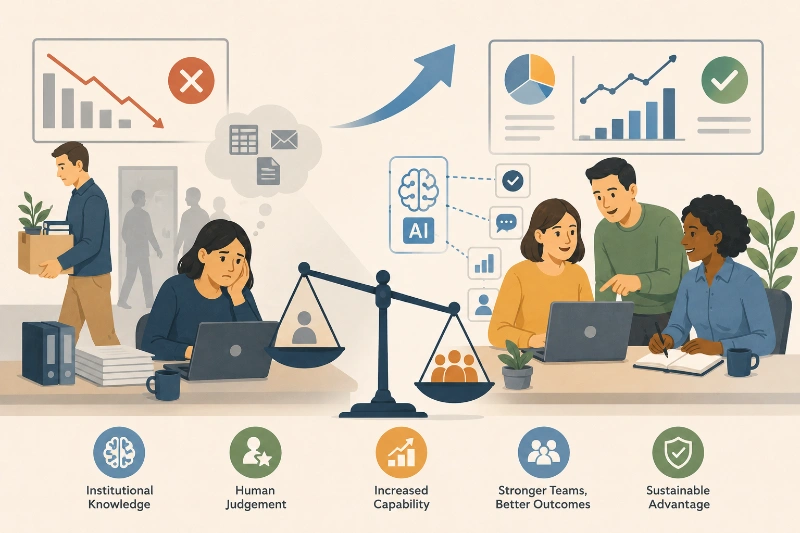
Instead of viewing AI as a job killer, some companies are shifting gears. They’re using AI to amplify human skills, freeing workers from repetitive tasks and letting them focus on complex challenges. This isn’t about replacement; it’s about collaboration. The real power lies in blending AI’s speed and scale with human judgment and creativity—a balance that preserves expertise while pushing productivity forward.
Risks of Headcount Cuts Driven by AI
The rush to slash headcount as AI tools roll out is more dangerous than many admit. When companies opt for immediate cost savings by cutting staff, they often sacrifice deep institutional knowledge that took years to build. This knowledge isn’t just facts stored in databases—it’s the nuanced understanding of processes, client relationships, and problem-solving approaches that AI can’t replicate. Losses here create gaps that slow innovation and reduce agility.
Take the wave of layoffs in 2023 among some tech firms embracing AI-driven automation. While headlines touted efficiency gains, insiders reported growing operational friction. Teams struggled to onboard new hires quickly because the veterans who understood legacy systems were gone. The knowledge drain forced repeated trial-and-error and delayed critical decisions.
Moreover, the assumption that AI will replace workers outright underestimates the complexity of many roles. AI excels at automating routine tasks but falters on judgment calls requiring context, ethics, or creativity. Employees who remain often find themselves overburdened, juggling AI outputs and manual fixes. This mismatch erodes morale and drives turnover, compounding talent shortages.
Research from industry analysts confirms this pattern. Firms that invested in upskilling their workforce to collaborate with AI saw better retention and productivity. They leveraged AI to elevate human judgment rather than eliminate it. This approach preserved core expertise while enabling employees to focus on strategic challenges instead of mundane chores.
Cutting staff to chase short-term AI savings is a gamble that often backfires. The cost of lost knowledge and fractured teams can outweigh initial budget wins. Sustainable growth demands a shift away from headcount reduction toward integrating AI as a tool that enhances human capability. The companies that recognize this will avoid the pitfalls others are now encountering.
Augmenting Skills Over Replacing Staff
The rush to slash headcount in the name of AI efficiency often overlooks a critical factor: the knowledge people carry. Institutional memory isn’t just data stored somewhere—it’s experience, context, and intuition woven into daily operations. When companies cut staff indiscriminately, they risk erasing this subtle but essential asset. AI tools, no matter how advanced, can’t replicate years of nuanced understanding or the human judgment that guides complex decisions.
Instead, AI’s real potential lies in amplifying human skills. By automating repetitive tasks, it frees employees to focus on higher-order thinking—problem-solving, strategy, and creative innovation. This shift demands more than plug-and-play technology; it requires deliberate investment in training and cultural change. Employees need to learn how to work alongside AI, interpreting its outputs and applying them wisely.
Some forward-thinking organizations have already started down this path. They view AI as a collaborator, not a replacement. Their workforce evolves, gaining new capabilities instead of shrinking. This approach preserves critical expertise while unlocking fresh value. It’s a different mindset—one that treats AI as a tool for empowerment rather than a shortcut to fewer heads.
Building Sustainable Growth with AI
The rush to slash headcount in the name of AI-driven efficiency often backfires. When organizations trim staff aggressively, they risk erasing decades of tacit knowledge—those unwritten rules and nuanced understandings that AI can’t replicate. This loss isn’t just a short-term hit; it undermines resilience and innovation capacity over time. Institutional memory matters, especially in complex fields like cybersecurity, where context and experience shape effective responses.
Instead, companies that invest in upskilling their workforce to work alongside AI see a different outcome. AI takes over repetitive, time-consuming tasks, freeing employees to focus on higher-level problem-solving and strategic thinking. This shift doesn’t just improve productivity; it enhances job satisfaction and retention. Workers become partners in innovation rather than casualties of automation.
Building sustainable growth means embedding AI as a tool that amplifies human capabilities rather than replaces them. It requires deliberate policies—training programs, cross-functional teams, and feedback loops—that align AI deployment with human expertise. Firms that adopt this collaborative approach tend to outperform those chasing quick labor cost cuts. The market rewards adaptability and depth of skill, not just lean headcounts.
The debate isn’t about AI versus humans. It’s about how organizations choose to integrate new technology without sacrificing the knowledge and skills that drive long-term success. Those that get this balance right will set the pace in an increasingly AI-enabled world.
Rethinking AI as a Human Expertise Multiplier

AI isn’t just a tool to slash payroll. It’s a force multiplier for human expertise—if used right. Organizations that rush to cut headcount risk erasing years of hard-earned knowledge that no algorithm can quickly replace. Instead, AI should be deployed to amplify what employees already know and do well. Think of it as freeing people from repetitive chores so they can focus on complex problem-solving and strategic thinking. The real advantage lies in training teams to work alongside AI, blending human judgment with machine efficiency. Those who invest in this balanced approach stand to build resilience and innovation, rather than short-term savings. It’s a shift from seeing AI as a replacement to recognizing it as a partner in sustaining growth.
Global Digests News delivers timely, credible coverage of world affairs, politics, economy, and technology to keep you informed on today’s top stories.
